
Napkin 19th c.
Collection of the State Museum of the Republic of Kazakhstan. 19th century. Donated by A. Kaimbaev in 1984
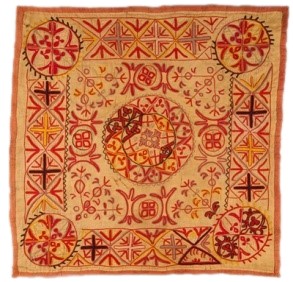
The edges of the napkin are trimmed with printed satin, which forms an expressive decorative border and emphasises the compositional boundaries of the piece. The central field is adorned with a large circular rosette, which serves as the compositional centre of the piece. The rosette is executed as a stylised floral motif, around which the entire ornamental scheme is arranged. Four smaller rosette compositions are situated in the corners, harmoniously balancing the central element and forming a cohesive decorative structure.Stylised floral forms intertwine with geometric elements, creating a rhythmic and balanced composition. The ornament is executed in coloured threads, which lends the piece decorative expressiveness.Overall, the napkin demonstrates the characteristic features of traditional textile decoration: symmetry of composition, rhythmic repetition of motifs, and a harmonious combination of colour and ornament.