
Bilezik
Semipalatinsk Region. Silver, engraving, casting, repoussé, carving. A. Kasteyev National Museum of Arts of the Republic of Kazakhstan
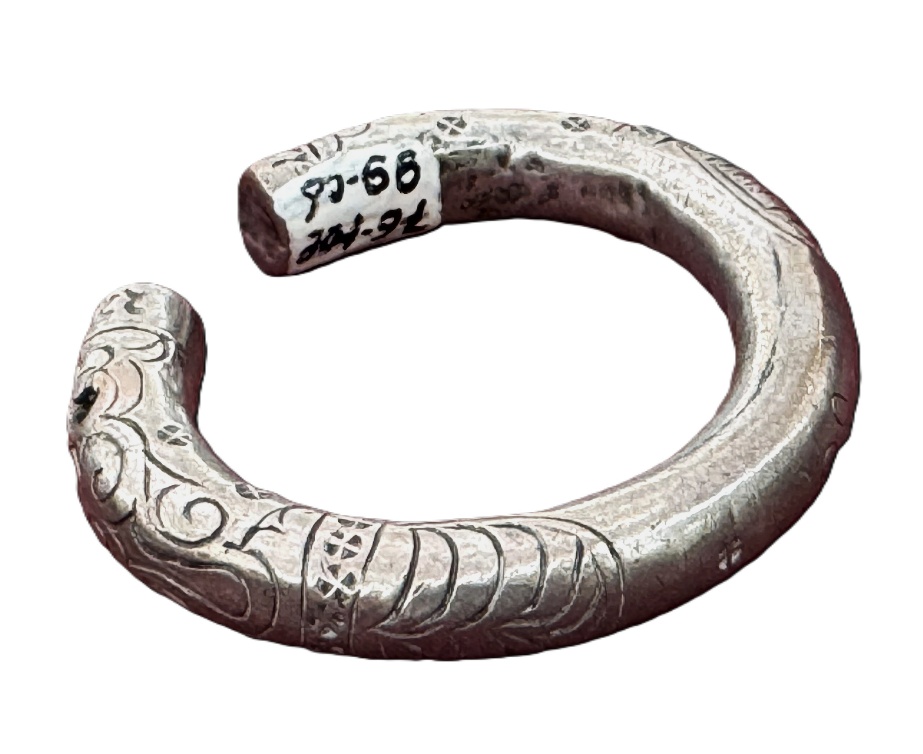
Bilezik — an open-ring-type wrist ornament characteristic of the traditional jewellery art of Eastern Kazakhstan (Semipalatinsk region) in the 20th century. The piece belongs to the category of everyday decorative jewellery and is distinguished by its concise yet expressive form.The material is silver; the techniques used include casting, chasing, carving and engraving. The ornamentation is formed by a recessed and linear pattern that emphasises the shape of the piece.The design consists of a solid, round-sectioned base with open ends. The ends are thickened and slightly profiled; one of them has a gently curved, stylised shape, which lends the piece a sculptural expressiveness. The shape of the bracelet is characterised by its compactness and functional simplicity.The composition follows the contour of the piece and has a continuous linear character. The ornamentation is distributed across the entire surface, though it is more densely developed at the ends, where the main decorative elements are concentrated. The central part is decorated more modestly, creating a visual balance.The ornamental scheme combines geometric and plant-zoomorphic motifs. The design of the ends features stylised elements reminiscent of generalised animal forms or horn-like motifs characteristic of traditional ornamentation. Linear incisions and engraved bands create a rhythm and emphasise the structure of the form. Overall, the piece demonstrates a consistent tradition of minimalist yet meaningful decorative design.