
Vessel from the ‘Landscapes’ series, 2013. Earthenware, glaze. Source: Kazakh Art, Volume 5. Almaty, 2013
Reshat Kozakhmetov
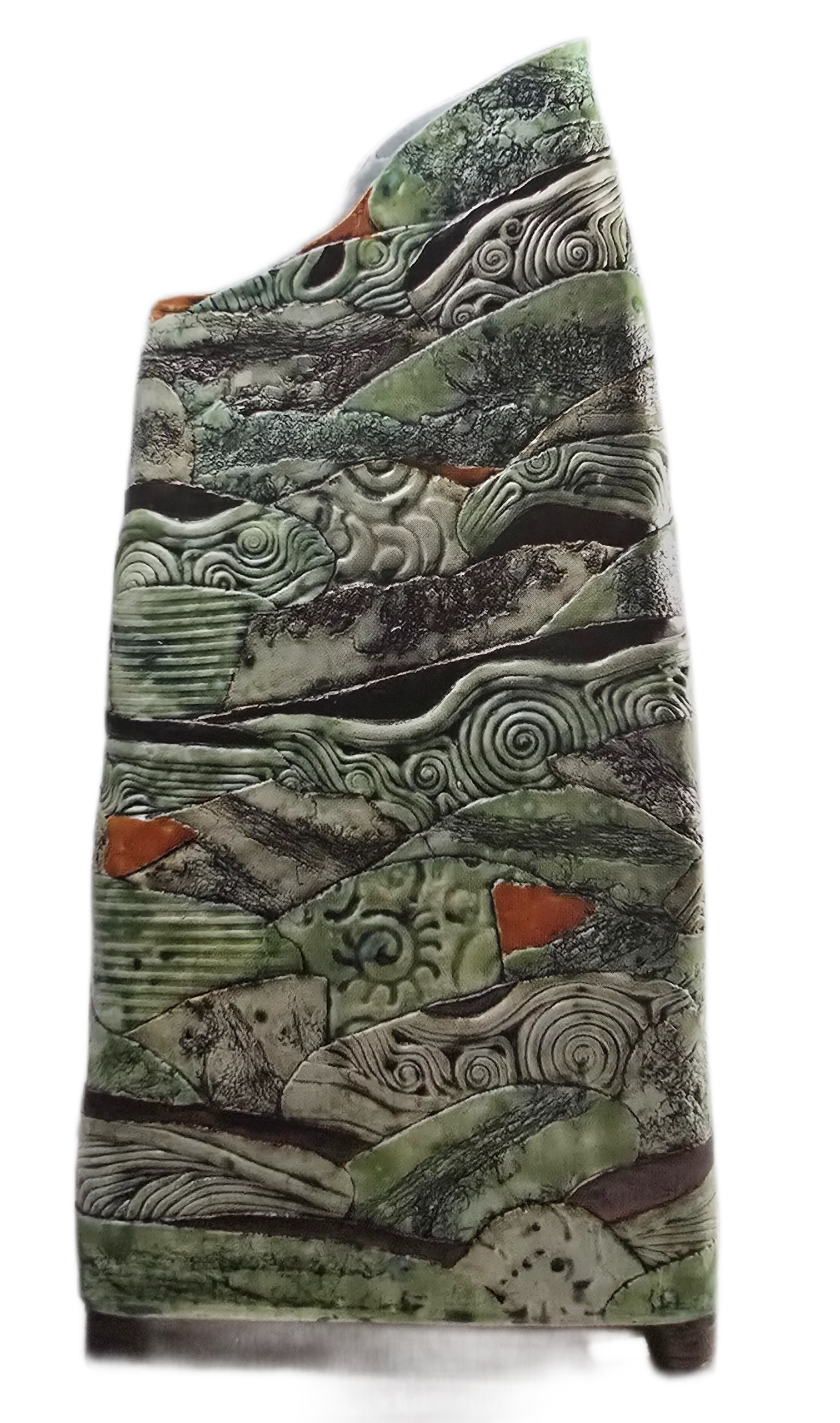
This work from the ‘Landscapes’ series is an example of contemporary artistic ceramics, in which the utilitarian form of the vessel is transformed into an independent sculptural object, verging on sculpture. The surface of the work is literally ‘woven’ from multiple layers and imprints, forming a dynamic system of lines and textures. Spiral motifs, undulating rhythms and rough patches evoke associations with geological cross-sections, soil erosion or the panorama of a hilly landscape. This interpretation of form shifts the object from the realm of decorative and applied art into the realm of metaphorical reflection on nature. Here, the texture serves not merely as a decorative element, but as a kind of ‘archive of the earth’s memory’, recording the traces of time and natural processes.The colour scheme reinforces this natural imagery. The plasticity of the form plays a particular role. The massive volume, tapering towards the top, and the asymmetrical rim disrupt the classical symmetry of a ceramic vessel. As a result, the object takes on the appearance of a monolithic rock or a natural formation subjected to the effects of time and the elements.