
‘Evermust’ (‘Everything Must’), 2017
Zoya Falkova • Art object. Faux leather, filling, paint. 5 × 45 × 40 cm. The ‘Bad Jokes’ exhibition in Astana. Curated by Valeria Ibraeva
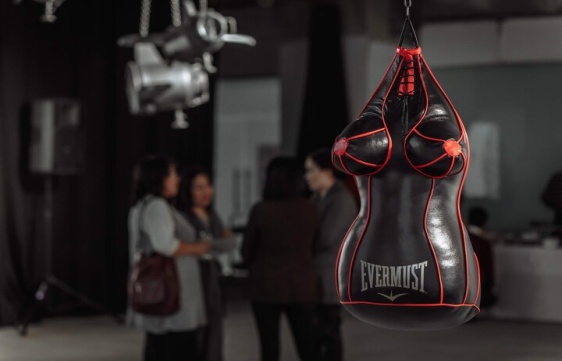
Zoe Falkova’s art installation – the ‘Evermust’ punching bag, presented as a female torso – imitates a real Everlast sports punching bag. The artist’s project – a social sculpture – has been exhibited in Almaty, Berlin, Düsseldorf, Astana and Bishkek. The artist’s main aim is to draw public attention to pressing issues of gender equality in global society, as set out in the UN Charter. The ‘Evermust’ punching bag (which translates as ‘Everything Must’) offers only soft and light resistance when one attempts to use it for its intended purpose, which is uncharacteristic of a hard sports implement. ‘Can and should a woman’s body be a pear?’ asks the artist. This parallel between tactile sensations is comparable to gender stereotypes of behaviour: masculine and feminine interaction. The artist’s work, exhibited at the first Feminist Art Biennale – Feminnale, dedicated to the theme of violence against women and held at the T. Aitiev National Museum of Fine Arts (Bishkek) in 2019, was, like some works by other artists, ‘censored’ and removed from the exhibition. This action by the authorities was widely discussed within the international community. As a result of the debate, Falkova’s art installation was acquired by the ‘Museum of Forbidden Art – Museu de l’Art Prohibit’, founded by Tacho Bennet in Barcelona.
Photo: Batyr Aubakirov
Source: https://forbes.kz/articles/rabota_kazahstanki_popala_v_collection_of_the_Museum_of_Forbidden_Art_in_Barcelona