
Aday carpet 19th c.
2nd half of the 19th century. Collection of the Mangystau Regional Museum of History and Local Lore
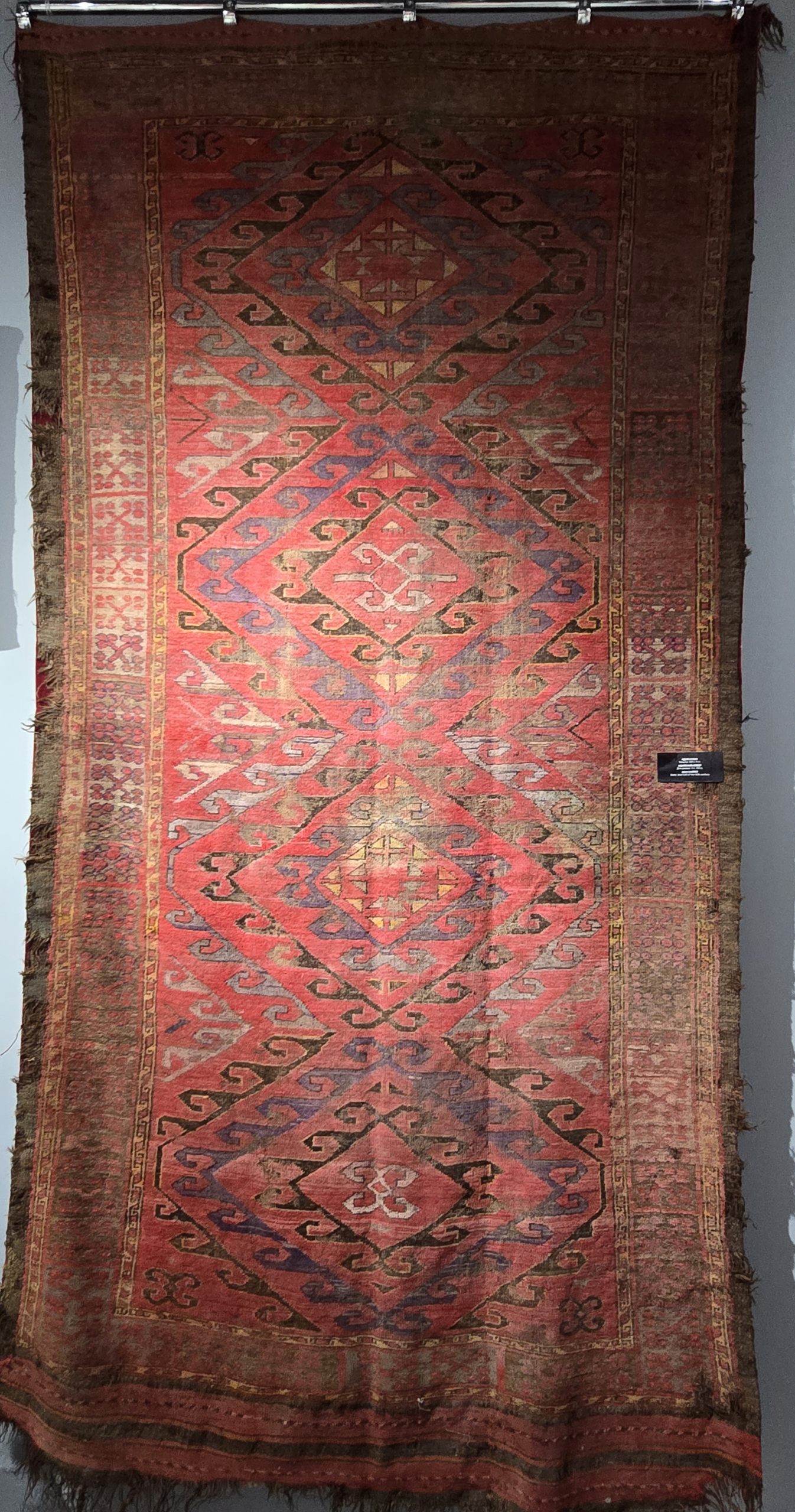
The central field of the carpet is occupied by four large diamond-shaped rosettes, within which smaller figures are inscribed. The outline of the diamonds is formed by horn-shaped curls, which lend the composition plasticity and dynamism. In several places, the weaver introduces elements resembling arrows, enhancing the graphic sharpness of the ornament.The wide border is decorated with cross-shaped figures, creating the impression of a protective belt around the central field. Whilst red dominates, the colour palette remains rich: shades of green, blue and yellow are used, enhancing the decorative expressiveness.The researchers were particularly drawn to horn-shaped motifs with pointed ends. The German ethnographer Richard Karutz identified such ornaments from Western Kazakhstan with arrowheads, citing the folk beliefs of the Mangystau Kazakhs regarding ‘fiery arrows’—lightning and thunderbolts. According to these beliefs, the heavenly arrows are the result of a battle between the angel who controls the clouds and an evil force. The scholar emphasised that the images of the angel and the devil in the Kazakh consciousness serve as an Islamised shell for more ancient animistic beliefs.Karutz also wrote about the arrow motif as a distinct element in Mangystau ornamentation. In this context, it is possible to suggest that the arrow-shaped elements of the ‘Adai kilem’ reflect the Adai clan’s tamga – ‘ok’ or ‘zhebe’ (arrow, bow). Thus, the carpet’s ornamentation can be interpreted not only as a decorative element, but also as a sign of clan identity, sacred protection and a connection to ancient mythological concepts.