
Besik
Willow, traditional manufacturing technique. First half of the 20th century. Sherbakulsky Museum of History and Local Lore • Besik. 18th century. Collection of the Turkestan Regional Museum of History and Local Lore.
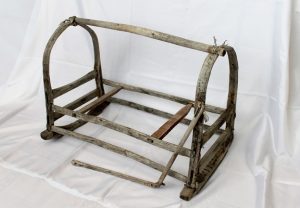
Besik is a traditional cradle, whose sacred origins are shrouded in legend. There are strict rules and prohibitions regarding the use of the cradle; for example, one must not rock an empty cradle, or one may be left without children. Ritual celebrations, such as the first time a child is placed in the cradle – “Besik salu” – are held with wishes for the baby’s health and well-being. “The process itself begins with singing: the child’s cradle is the door to the universe (balanyn besigi – ken dunienin esigi, Tole-bi)” (Nurlanova 22). There is a popular belief that trees, as natural apotropaic symbols, protect children’s health from all kinds of everyday misfortunes and calamities. In the folklore studied, “… among all the Turkic-speaking peoples of Siberia, trees feed (give birth to) children; they are a symbol of life and a guarantee of the well-being of the members of the clan” (Oktyabrskaya et al. 32).The cradle was made of meadowsweet, poplar or willow and other hard woods. The cradle had a modular design: the cradle itself or box; legs, sometimes placed on bent wooden slats, allowing the cradle to be rocked; a long handle – belagash, connecting the ends of the cradle. To decorate the cradle, craftsmen used many artistic techniques of woodworking: turning, carving, painting, applying ornaments with benevolent meanings: family tamgas, koshkar muiiz, etc. The importance of the besik symbol to the people is reflected in the profound and apt expression: “El bolamyn deseң besigіңді tүze.” The meaning of the saying is that for the life and development of a prosperous people, it is important to preserve their roots and nurture traditions in new generations.