
Bilezik
West Kazakhstan. Silver, blackening, engraving. A. Kasteyev National Museum of Arts of the Republic of Kazakhstan
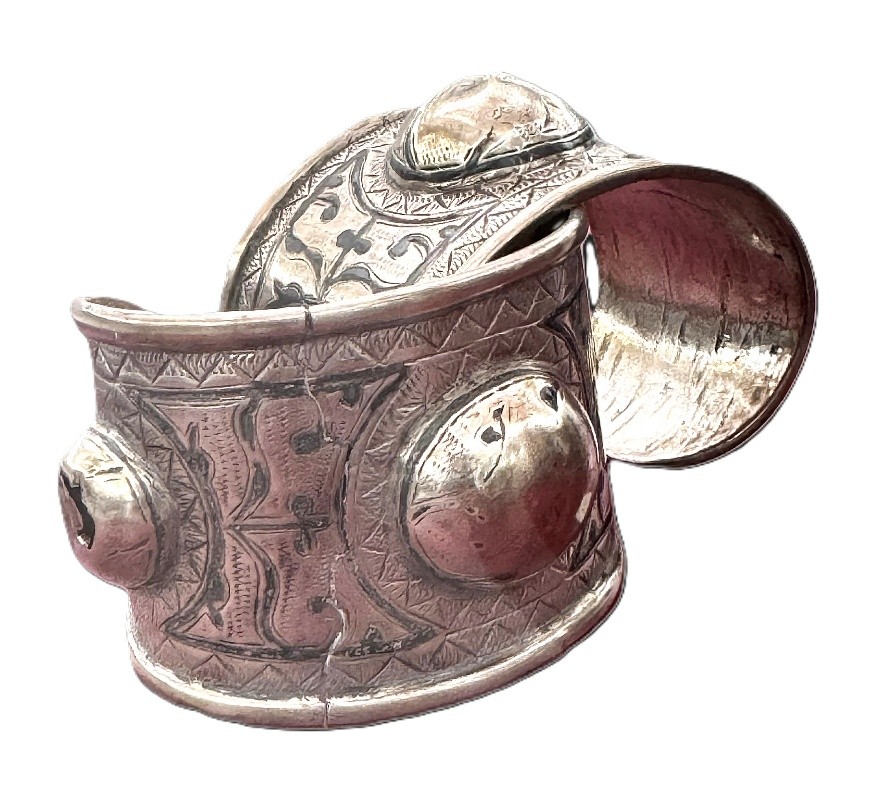
A bilezik is a cuff-style wrist ornament characteristic of the West Kazakh tradition of jewellery art from the late 19th to early 20th centuries. The piece belongs to the ceremonial category and is distinguished by its complex sculptural design.The material is silver; the techniques used include engraving and blackening. The use of blackening emphasises the ornamental pattern, creating a contrast between the recessed and protruding areas of the surface.The design consists of a solid bracelet-like form with an open base and a hinged element. The upper part of the piece is enhanced by an additional overlay plate, forming a protruding decorative accent. The side surfaces are adorned with three-dimensional hemispherical overlays, which accentuate the relief and the structure of the form.The composition is structured according to the frieze principle, with a central ornamental zone highlighted. The main field is decorated with an engraved floral ornament, rendered as symmetrically unfolding shoots and scrolls. Additional geometric elements, including triangular and linear motifs, form framing bands and emphasise the design of the piece.The ornamental scheme combines floral and geometric motifs. The blackening enhances the graphic quality of the design and makes the ornamentation more expressive. Three-dimensional overlays create a play of light and shadow, lending the piece a sense of sculptural richness. Overall, the ornament demonstrates the Western Kazakh school’s characteristic tendency towards complex forms and rich decorative solutions.