
Yuzik
East Kazakhstan. Silver, embossing, blackening, engraving. A. Kasteyev National Museum of Arts of the Republic of Kazakhstan
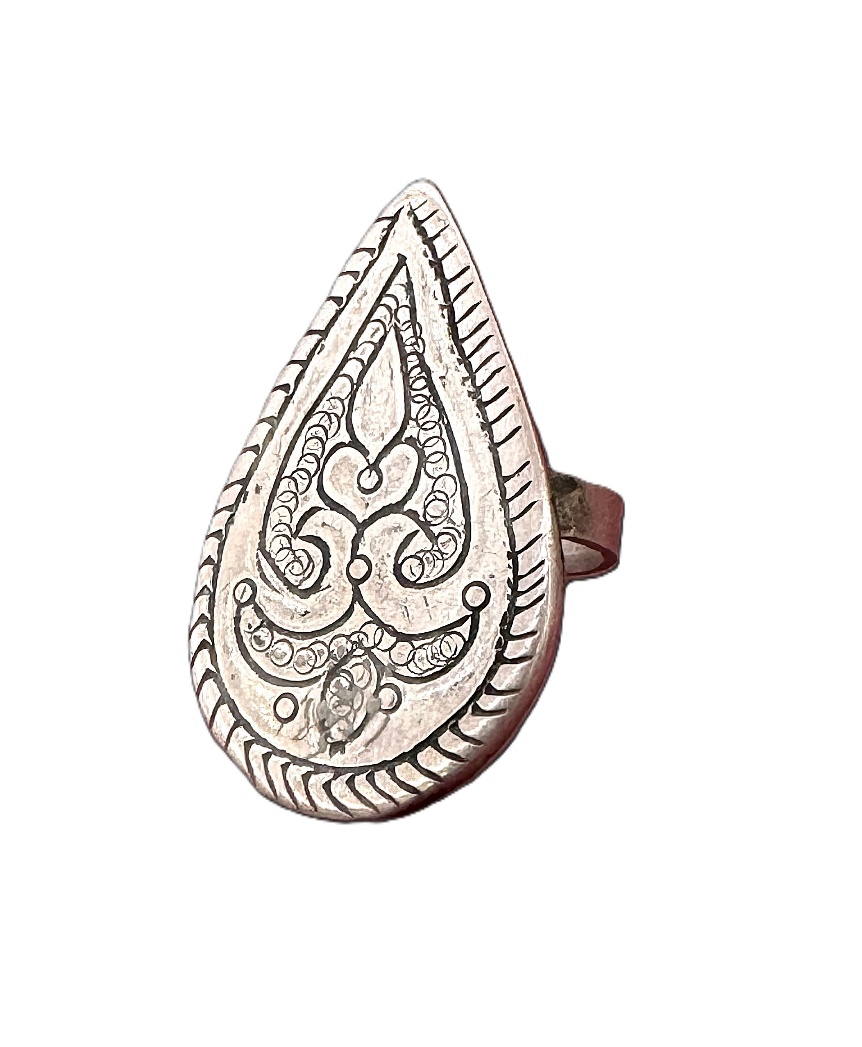
Ring (juzik), a type featuring an elongated teardrop-shaped face. The ring is a traditional piece of women’s jewellery serving both decorative and amuletic purposes, distinguished by the elongated shape of its face and elaborate ornamental design.The design features a shank that widens gradually at the top, transitioning into a large teardrop-shaped (pear-shaped) shield. The shield is raised above the base and framed by a relief border with incisions forming a closed contour. The surface of the piece is made entirely of metal, without any inlays.The composition is structured according to a strictly axial principle with a pronounced vertical orientation. The central field is organised as an elongated inner form inscribed within the shield’s outline. The ornamentation develops from the lower part towards the apex, forming a gradual narrowing and emphasising the highest point of the composition.The ornamental system combines plant and spiral motifs characteristic of traditional ornamentation. In the central zone, stylised elements of the ‘koshqar muiz’ type can be seen, complemented by fine grain-like decoration arranged in the form of framing lines. The lower part is accentuated by a small relief element serving as a compositional conclusion.The embossed relief, followed by the blackening of the recesses, creates a contrast between the light surface and the dark linear pattern, enhancing the graphic quality and legibility of the ornament. Overall, the piece demonstrates the orientation towards elongated forms, clear symmetry and the plastic expressiveness of the ornament characteristic of the East Kazakh tradition.