
Kapsyrma
Northern Kazakhstan. Silver, blackening, engraving, embossing. A. Kasteev National Museum of Arts of the Republic of Kazakhstan
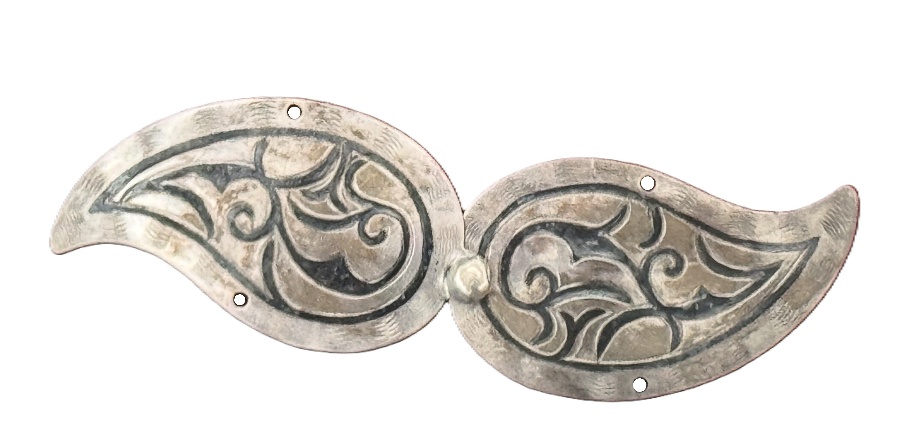
Kapsyrma (clasp). This item is a belt fastener designed to join sections of a belt or garment, whilst also serving as a decorative feature. The design comprises two panels connected by a hinge, ensuring flexibility and ease of use.The composition is based on the principle of mirror symmetry, yet is distinguished by the elongated, asymmetrically curved shape of each flap, reminiscent of a stylised leaf or horn-like motif. When closed, the elements form a dynamic, flowing line characteristic of Kazakh ornamental design.The ornamental scheme features plant motifs with a pronounced spiral structure. Curls and shoots form a continuous ornamental flow that follows the contours of the piece. The blackening technique enhances the contrast between the background and the design, emphasising the depth of the engraved and embossed relief.Technologically, the piece is crafted using embossing to create volume and engraving to detail the ornamentation. Blackening is applied to accentuate the lines and create graphic expressiveness.Overall, the clasp reflects a tendency characteristic of the North Kazakh tradition towards a freely interpreted form, where the ornament and the outline of the piece form a single artistic whole, and the functional element acquires its own aesthetic significance.