
Composition, 2024. Aluminium. Almaty
Alibek Mergen
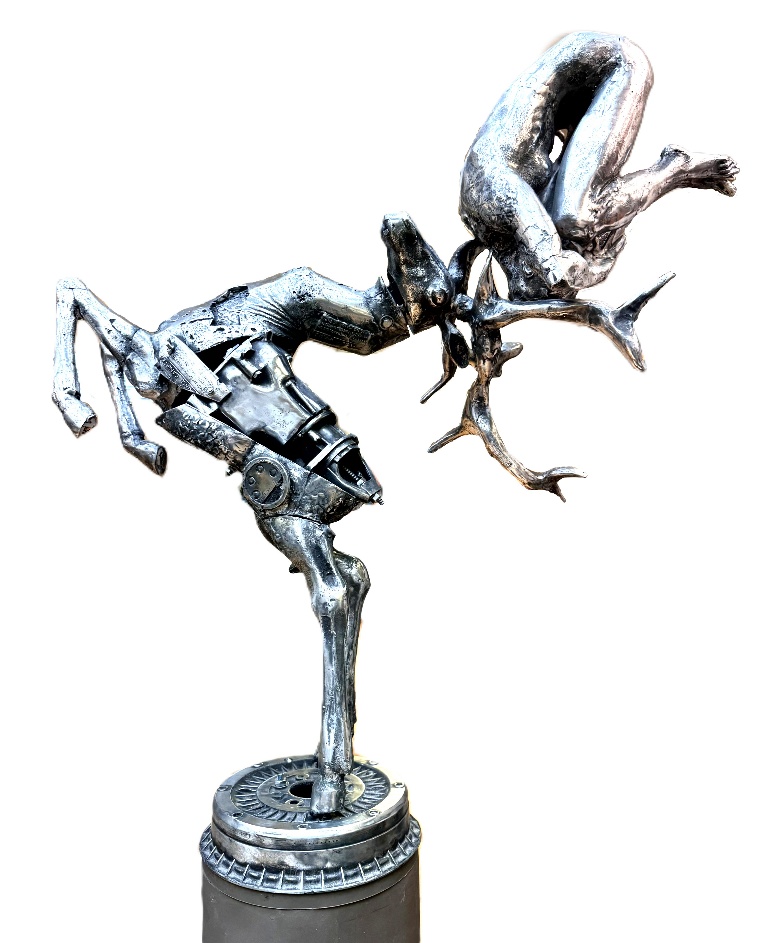
The sculptural form of the work is built on the combination of organic, anthropomorphic and mechanised elements, forming a complex hybrid structure. The sculpture is made of aluminium, thanks to which the composition, despite its massive character, retains a visual lightness and spatial fluidity. The material allows the artist to combine structural clarity with subtle surface detailing, enhancing the sense of the form’s multi-layered nature.The composition develops diagonally and is based on the principle of precarious equilibrium. The figure seems to balance in space, creating an impression of tense movement and internal momentum. The main sculptural emphasis is concentrated in the upper part, where elements intertwine, simultaneously evoking the human body, horn-like natural structures and fragments of mechanical constructions. The elongated lower support stabilises the composition, whilst reinforcing its vertical orientation and the sense of dynamic ascent.The work’s artistic language is based on the principle of hybridising forms. The human figure here does not retain its anatomical integrity: the body is dismembered, transformed and joined with mechanical and biomorphic elements. As a result, the image finds itself on the borderline between a living organism and an artificially constructed object. This kind of plastic ambiguity becomes the work’s key means of expression.The surface of the aluminium is organised as a complex textured medium. Smooth, almost polished planes alternate with rough areas that retain traces of active processing. This heterogeneity reinforces the impression that the object is assembled from disparate fragments and emphasises the processual nature of the form. Light, reflecting off the metal surface, reveals the complex structure of the volumes and makes the composition visually changeable when viewed from different angles.The work’s thematic content relates to the theme of transformation and instability in the modern world. The fusion of organic and mechanical elements can be interpreted as a metaphor for human existence in a technogenic environment, where the boundaries between nature, the body and technology are gradually blurring. The internal tension of the composition heightens the sense of conflict between the natural and the artificial, between the biological and the constructed.