
Zheti AnaLocation: Almaty, Medeu Park Hotel Source: the artist’s personal archive
Saule Suleimenova
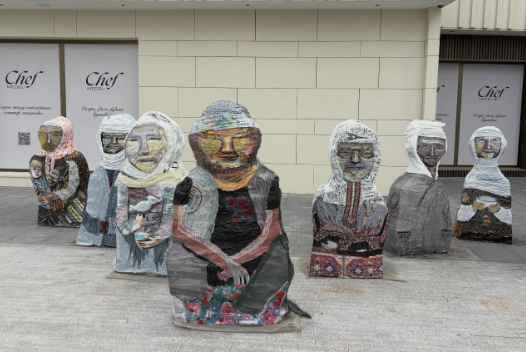
The installation ‘Zheti Ana’ is a significant artistic statement dedicated to re-examining the mechanisms of cultural memory and the place of women in the history of the clan. Drawing on one of the fundamental traditions of Kazakh culture—the knowledge of one’s ancestors back to the seventh generation (‘Zheti Ata’)—the artist raises the issue of the invisibility of female genealogy, whose representatives, despite their key role in perpetuating the lineage, often remain outside the historical and family narrative.The conceptual basis of the work is the symbolic juxtaposition of male and female memory. Whilst the ‘Zheti Ata’ tradition establishes a vertical line of patrilineal descent, ‘Zheti Ana’ proposes to restore the lost connection with the maternal line, returning to women the right to be present in collective memory. The seven female figures are presented not as individual portraits, but as archetypal images of mothers, foremothers and guardians of the clan, embodying the continuity of generations and the transmission of life experience.The seven ‘balbal’ figures are made from plastic bags and packaging – everyday objects that are usually perceived as temporary, insignificant and devoid of value.