
‘Daughter of the Steppe’. Felt. 2015, Source: https://businessfm.kz
Aitkaliev Kami
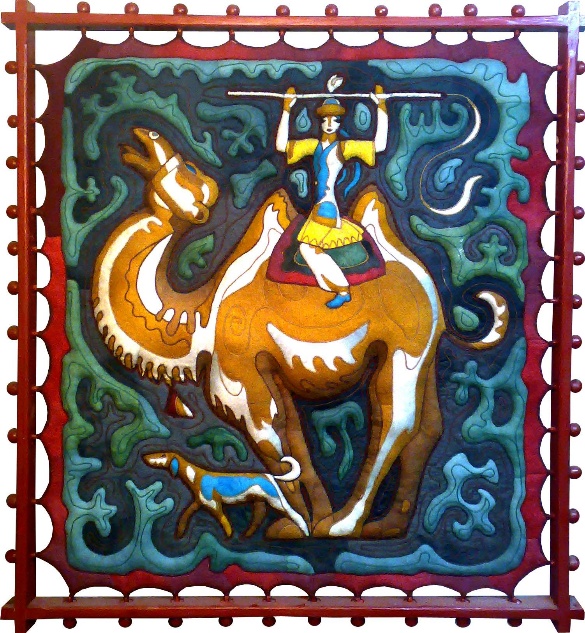
Kami Aitkalieva’s panel ‘Daughter of the Steppe’ is a striking example of neo-nomadic art, in which traditional forms of Kazakh art are given a contemporary artistic interpretation. The artist has succeeded in achieving a complex visual synthesis: preserving the material and symbolic memory of traditional felt, whilst simultaneously endowing it with new expressive possibilities characteristic of modernist and contemporary art.The artist goes beyond the confines of the classical two-dimensional approach, creating the effect of a distinctive ‘three-dimensional textile’. The central figure of the composition is a young woman riding a two-humped camel. This image embodies the idea of steppe freedom, strength and inner dignity. The figure of a Tazy greyhound running swiftly alongside adds further rhythm to the composition. The composition of the panel is centred, yet it is far from static thanks to the dynamic plasticity of its forms and lines. The panel vividly demonstrates the potential for reinterpreting traditional felt art, preserving its cultural identity whilst simultaneously opening new artistic horizons.