
Turquoise pendant, silver, turquoise; casting, engraving, filigree, granulation. Photo: A. Ibragimov, ‘Nomad Art’ exhibition and fair
Serikkali Kokonov
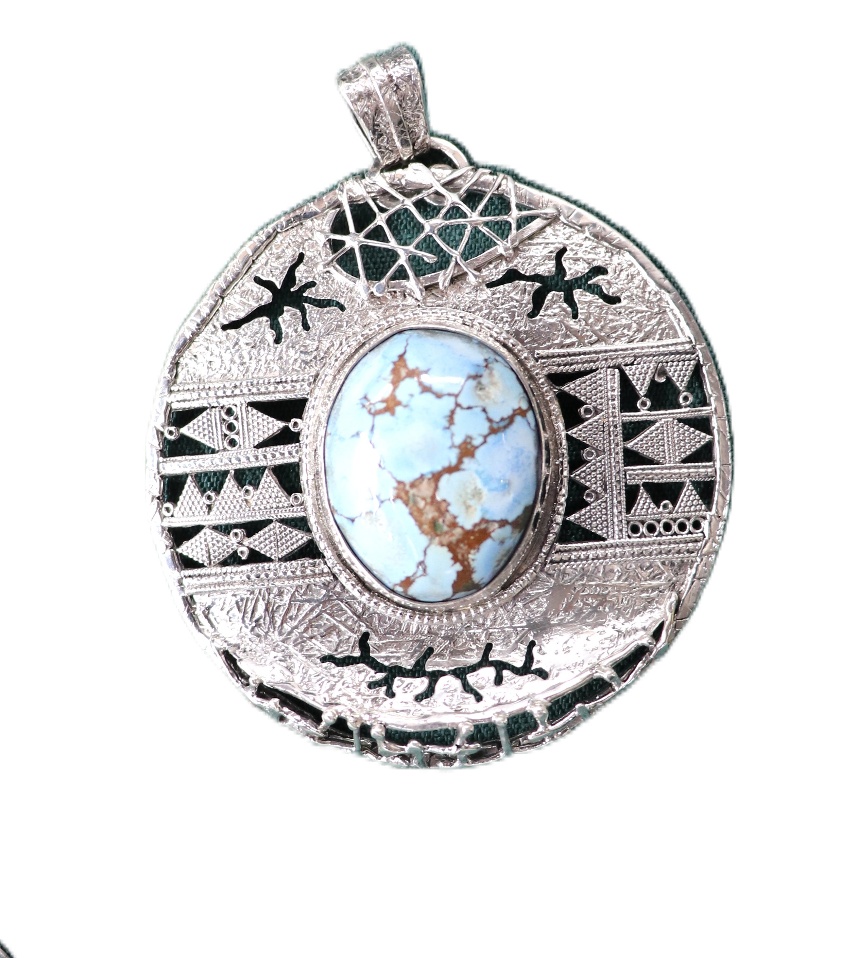
The central element of the pendant is a large turquoise inlay set in a metal frame. The composition is characterised by its unity and strict symmetry, with all decorative elements subordinated to a single axial structure.The basis of the artistic design is formed by a centric composition. The oval stone serves as the compositional core, around which a system of geometric and ornamental decoration is arranged. The surface of the piece combines smooth, relief and openwork sections, creating a complex interplay of textures. The side ornamental blocks are organised on a modular principle and built on the repetition of geometric motifs. The upper lattice insert enhances the sculptural richness and lends the composition additional depth.In traditional jewellery culture, turquoise is associated with notions of protection, well-being and inner harmony. Its central placement emphasises the stone’s sacred significance, whilst the surrounding ornamentation is perceived as a system of ordered symbols reflecting the idea of the harmonious order of the world. The contrast between the smooth surface of the mineral and the intricate metalwork enhances the expressiveness of the composition’s focal point.Of particular interest is the combination of traditional ornamental structure with the artist’s interpretation of form and texture. While preserving the canonical principle of centric decoration, the master complicates it through a variety of decorative techniques and sculptural detailing. As a result, the pendant is perceived not only as a decorative element, but also as an independent artistic object of contemporary jewellery art.