
Besik, 21st century. Wood, carving
Talgat Zhanasylov
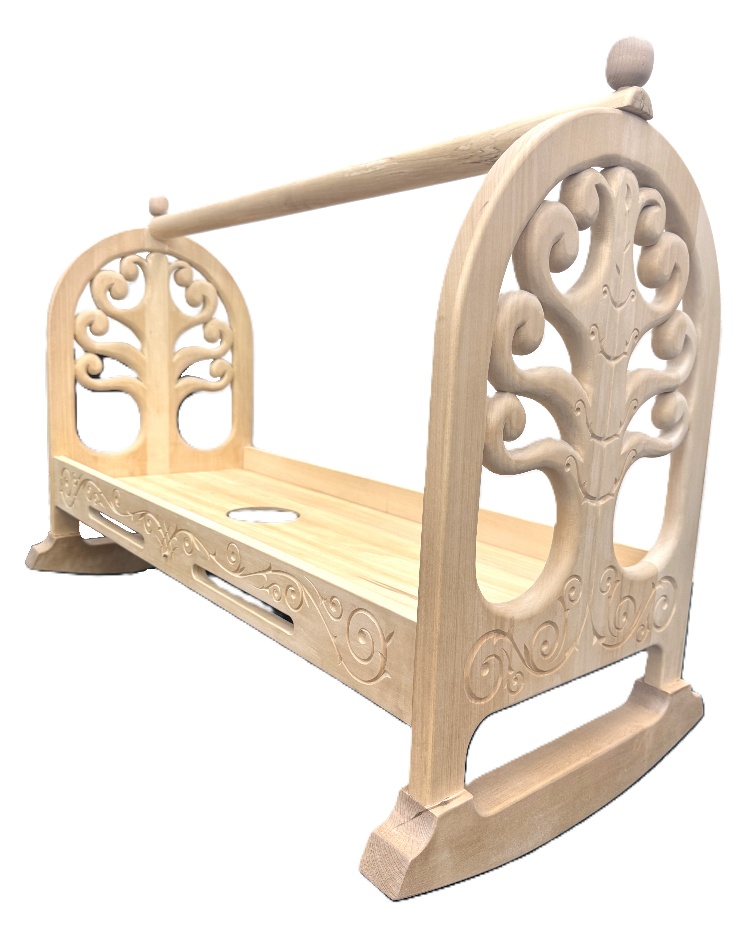
In this work, the traditional besik takes on the characteristics of an independent artistic object, whilst retaining the recognisable structural basis of the Kazakh cradle. The arched base, side supports and longitudinal crossbar reproduce the historically established form of the object, closely linked to nomadic culture and the practice of a mobile way of life.Whilst preserving the functional structure, the artist’s primary focus is on the sculptural and decorative treatment of the surface. The side elements are transformed into intricate carved compositions based on the ‘tree of life’ motif. The smooth flow of the lines, the gentle fluidity of the silhouette and the rhythmic organisation of the ornamentation form a cohesive artistic image in which structure and decoration exist as a unified system.The ornamental carving is not perceived as an external decoration of the object. On the contrary, the decorative motifs are organically integrated into the very structure of the form and emphasise its spatial organisation. Spiral and plant elements, characteristic of the Kazakh ornamental tradition, form a continuous sculptural rhythm that enhances the sense of growth and movement.Preserving the natural colour and texture of the wood plays a significant role. The avoidance of bold polychromy allows the focus to be placed on the depth of the carving, the play of light and shadow, and the natural texture of the material. As a result, the object retains a sense of artisanal authenticity and a close connection to the organic, natural essence of the wood.