
‘Roulette’, 2020
Saule Dusembina • Video animation. 0.12 mins
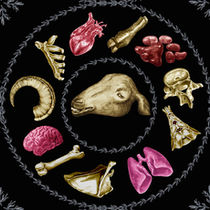
Saule Dusembina’s animated video is designed to be viewed in under a minute. Created in 2020 as an immediate social response from a socially conscious artist, the animation addresses the events of the ‘strange’ epidemic, the consequences of which humanity is still feeling today. In a brief description of the animation, the artist writes that the unfamiliar disease caused confusion in the city: treatment protocols were unclear, and the situation was frightening due to a shortage of medicines in the city’s pharmacies. Consequently, the population turned to traditional medicine, with its time-honoured methods of treatment. In the animation, the artist prominently features the central sacred symbol of Kazakh folk culture – the ram. The head of the sacrificial animal is depicted at the centre of a circle – a tondo. Around it, following the principle of the sectional divisions of a spinning roulette wheel – the wheel of fortune – the artist depicts human internal organs, evidently affected by the ‘spiky’ virus: the brain, blood vessels, kidneys and lungs, alternating with parts of the ram’s carcass, which have been recognised by the Kazakh people for many centuries as having healing properties. However, the similarity of these cultural and medicinal folk practices offers no guarantees: ‘Whoever is lucky will be lucky,’ the artist ironically sums up in her description of the project (https://www.sauledyussenbina.com/publications).
Source: https://www.sauledyussenbina.com/publications