Traditional and contemporary art of Kazakhstan

A Virtual Journey into the World of Kazakhstan’s Artistic Heritage

This Web Gallery presents the diversity of artistic practices in Kazakhstan, reflecting the continuity of cultural traditions and the dynamic development of contemporary creative processes. The virtual exhibition features works based on national images, symbols, and themes, as well as artworks by contemporary artists who reinterpret the country’s cultural heritage through contemporary artistic forms, expressive means, and modern technologies.

The selected works demonstrate the relationship between traditional and contemporary art, revealing the distinctive features of the national worldview, cultural identity, and cultural meanings. The presented materials allow viewers to trace how elements of historical and cultural heritage are reflected in contemporary artistic practice, while maintaining their significance and relevance in an increasingly globalized world.

The Web Gallery is aimed at promoting Kazakhstan’s artistic heritage, expanding public access to works of art, and fostering a lasting interest in national culture and art among a wide audience.

Saddle pad 20th c.

Turkestan Regional Museum of History and Local Lore
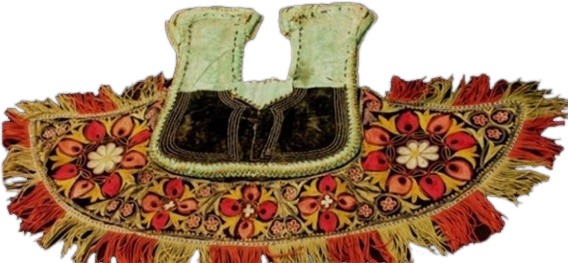
The item is made of felt. It has a rectangular shape with ‘wings’ and is trimmed with velvet on top. The ornamentation consists mainly of plant motifs and features a rich colour palette, including shades of red, yellow and black.The composition of the item is symmetrical about the central axis. In the central part there is a recess corresponding to the shape of a saddle, around which the main ornamental composition is arranged. The decoration forms a semicircular shape encompassing the lower part of the garment. The ornamentation consists of large stylised flowers, rosettes and plant scrolls, combined into a rhythmically repeating pattern. The central floral elements are surrounded by smaller decorative details, creating a sense of depth and richness in the composition.The edges of the potnik are adorned with a fringe of coloured threads, which enhances the decorative effect and lends the piece a sense of dynamism. The fringe also serves as a distinctive frame for the ornament, emphasising the composition’s completeness.