
Dastarkhan
Kyzylorda Regional Museum of History and Local Lore
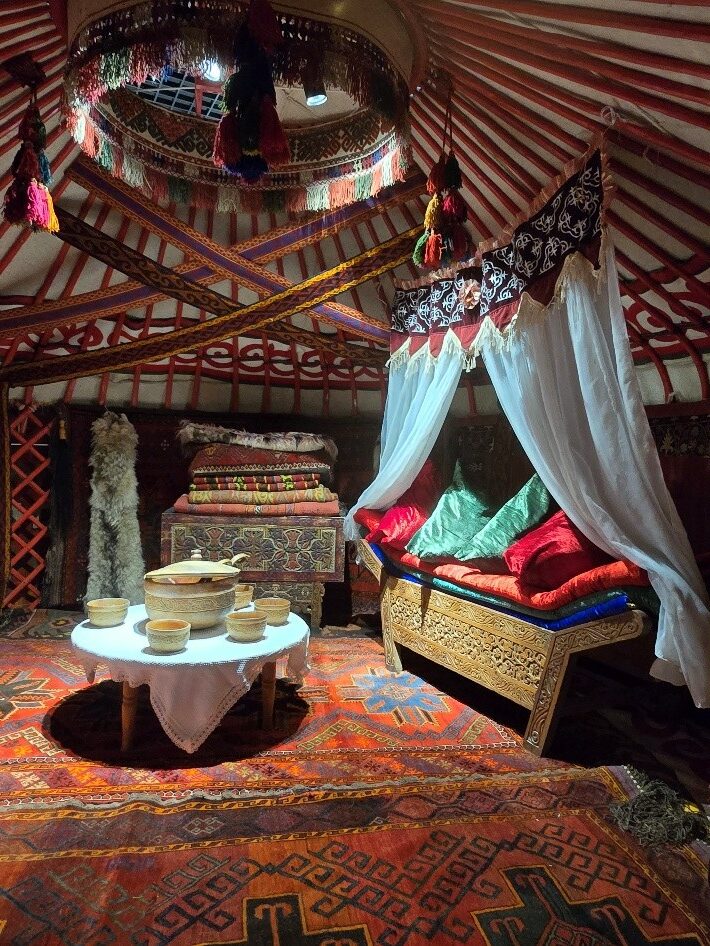
Dastarkhan – a table with low legs and raised edges of the tabletop was known to many tribes that inhabited the territory of modern Kazakhstan in early historical times: the Saka, Usun, Xiongnu, and ancient Turks. The word dastarkhan comes from the Iranian words dostur – tablecloth, khan – food (N.Zh. Shakhanova). Modern researchers interpret this polysemous word in different ways: not only a table, but also a tablecloth, and actually an attitude towards the world. Usually, a beautifully embroidered tablecloth was used to cover square or round tables, which were 30–35 cm high. However, the surface of the tabletop was often painted with ornaments. For example, there is a well-known colourful floral pattern, gül oyu, on a round tabletop, sketched by E.A. Klodt during an expedition to the Karaganda region in the first third of the 20th century. The tabletops were removable and after the communal meal ceremony they were stored separately. The importance of the dastarkhan in family life is determined by its place in the yurt: the table was located in its sacred centre, next to the hearth, and was a sign of family prosperity.