
Bilezik
West Kazakhstan. Silver, blackening, engraving, granulation. A. Kasteyev National Museum of Arts of the Republic of Kazakhstan
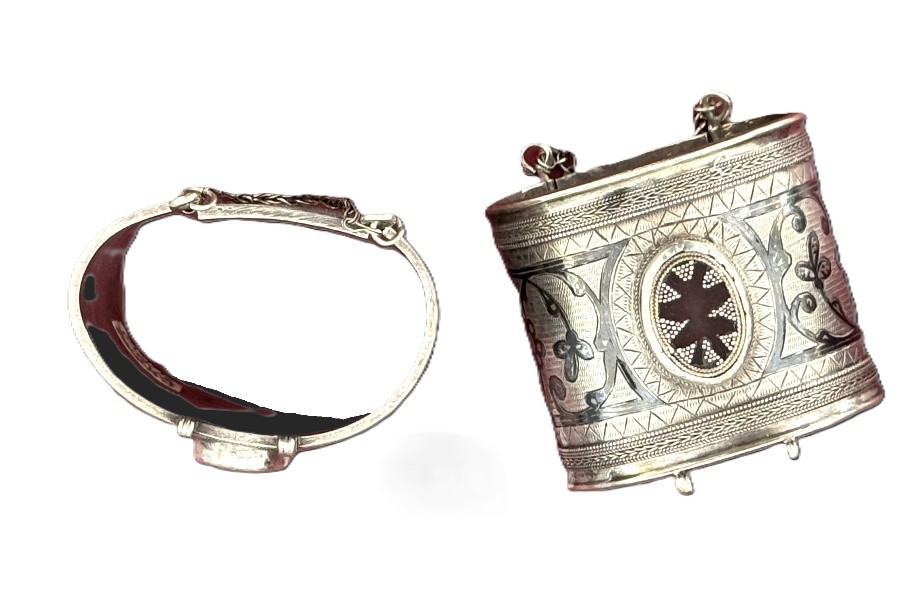
A Bilezik is a cuff-style wrist ornament characteristic of the West Kazakh tradition of jewellery art from the late 19th to early 20th centuries. The piece is a ceremonial item and is distinguished by its elaborate construction and rich ornamental decoration.The material is silver; the techniques used include engraving, blackening and granulation. The use of blackening emphasises the ornamental pattern, creating a contrast between the background and the design, whilst the granulation enhances the textural richness of the surface.The design consists of a solid cylindrical form of an almost closed type with a hinged joint. The upper part is fitted with loops for attaching hanging elements, indicating the original presence of additional decorative details. The lower part has small protruding supports, reinforcing the structural completeness of the piece.The composition is organised according to a frieze principle with a clear division of the surface. The central field is occupied by a large oval medallion with an openwork element in the form of a stylised rosette, serving as the compositional centre. The medallion is framed by geometric ornamentation and set within a system of plant motifs developing symmetrically on both sides. The upper and lower bands are decorated with linear and dentil ornamentation, emphasising the form’s boundaries.The ornamental scheme combines floral and geometric motifs with openwork elements. The contrast between the blackened background and the light metal enhances the graphic quality of the composition. The use of granulation creates the effect of a shimmering surface. Overall, the piece demonstrates the Western Kazakh school’s characteristic tendency towards complex composition, three-dimensionality and decorative richness.