
Rescuing a Dog Location: Almaty, Bolshaya Almatinka River Embankment Source: zakon.kz
Yerbosyn Meldibekov
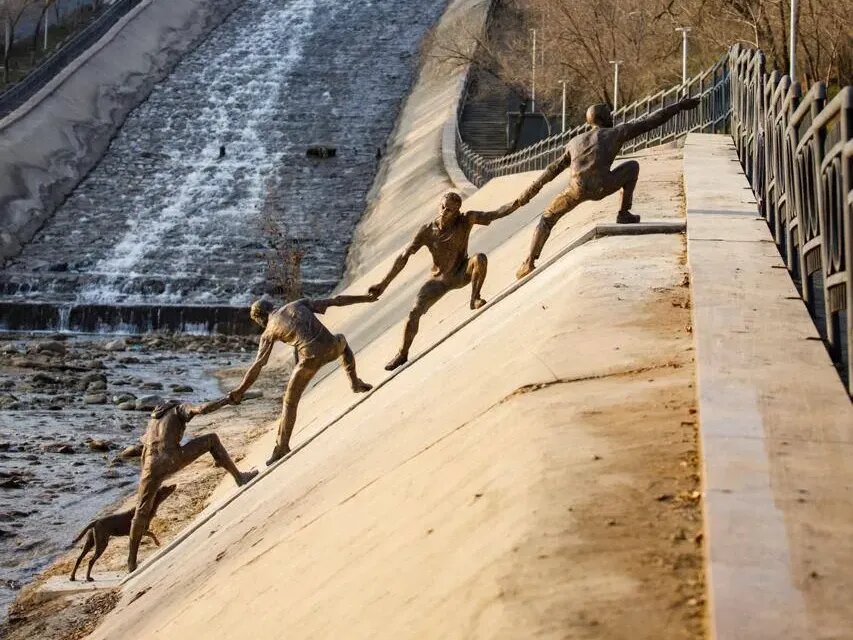
This sculptural composition is a striking example of socially oriented public art, in which the artistic image is formed at the intersection of sculpture, the urban environment and an important ‘message’. At the centre of the work is a group of four people, united in a single chain of mutual support. Holding hands firmly, they help one another to climb the steep slope along the riverbed, whilst the dog, which completes the composition, reinforces the sense of trust, loyalty and emotional connection between all those involved.The composition is based on the principle of dynamic movement. The figures are arranged diagonally, creating a sense of tension, of overcoming an obstacle and of an upward momentum. Each character simultaneously receives help and offers it to another, forming a self-contained support system. One of the monument’s most striking features is its organic interaction with the surrounding landscape. The artists did not simply place the sculpture within the urban environment; they integrated it into the existing infrastructure. As a result, the physical ascent up the sloping surface becomes a metaphor for life’s difficulties, whilst the environment itself begins to play a part in revealing the artists’ vision.