Traditional and contemporary art of Kazakhstan

A Virtual Journey into the World of Kazakhstan’s Artistic Heritage

This Web Gallery presents the diversity of artistic practices in Kazakhstan, reflecting the continuity of cultural traditions and the dynamic development of contemporary creative processes. The virtual exhibition features works based on national images, symbols, and themes, as well as artworks by contemporary artists who reinterpret the country’s cultural heritage through contemporary artistic forms, expressive means, and modern technologies.

The selected works demonstrate the relationship between traditional and contemporary art, revealing the distinctive features of the national worldview, cultural identity, and cultural meanings. The presented materials allow viewers to trace how elements of historical and cultural heritage are reflected in contemporary artistic practice, while maintaining their significance and relevance in an increasingly globalized world.

The Web Gallery is aimed at promoting Kazakhstan’s artistic heritage, expanding public access to works of art, and fostering a lasting interest in national culture and art among a wide audience.

Aksai Stream (detail), 2020. Wool, felt and stones

Saulė Bapanova
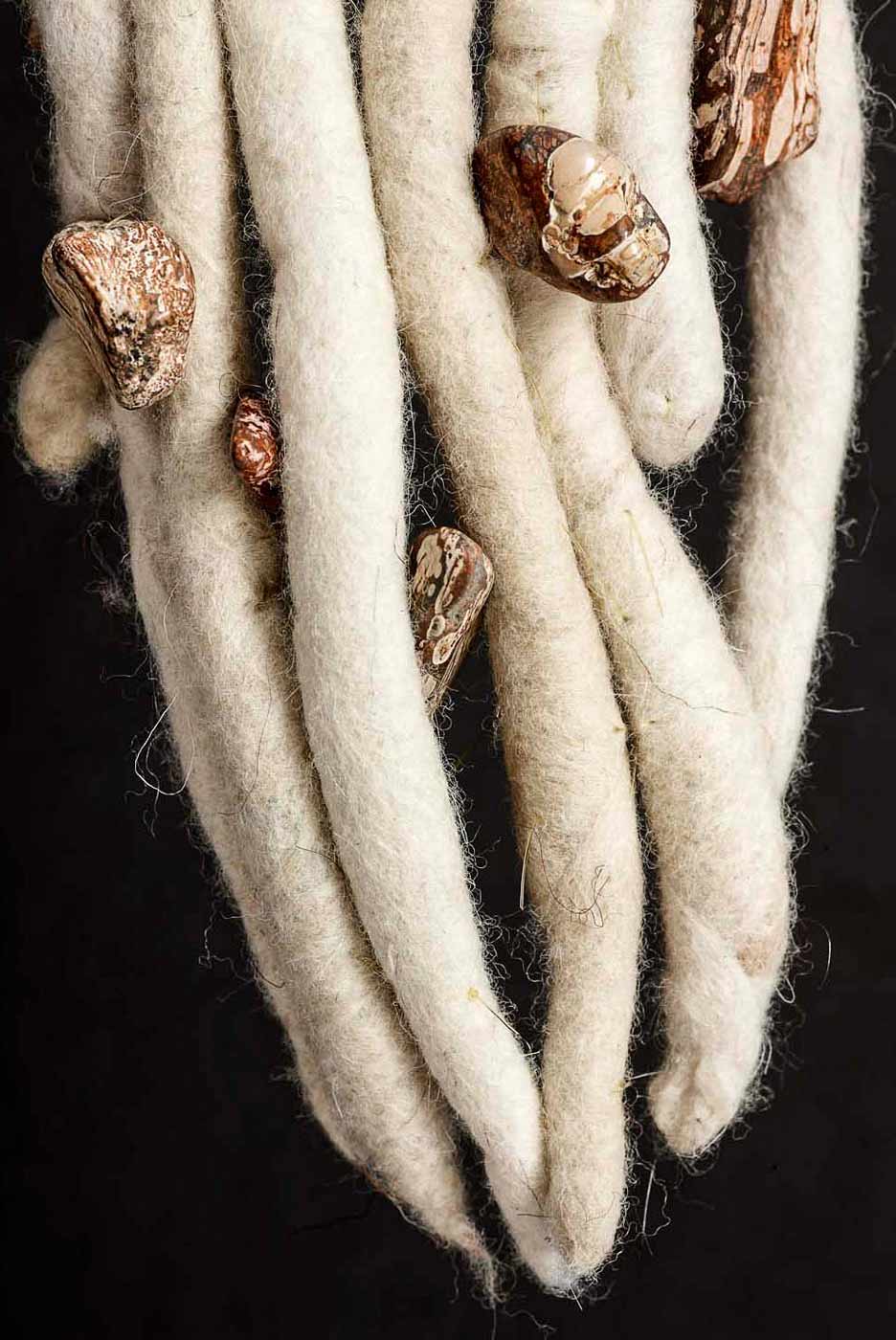
The work ‘Aksai Stream’ is an example of contemporary textile art in which natural materials are used as vessels of cultural and landscape memory. The work is based on the principles of tactile aesthetics and material symbolism, where texture itself becomes the primary tool for meaning-making.The material itself forms a semiotic opposition between ‘soft – hard’, ‘temporary – eternal’ and ‘human – natural’.Visually, the composition interprets the image of the Aksay mountain stream through the dynamics of woolen strands, which create a sense of the water’s movement. These organic lines form a metaphor for fluidity, in which the natural landscape is interpreted as a living process. In this context, the stones embedded in the fibrous structure function as traces of time — a kind of ‘archival fragment’ of natural history, capturing a moment of suspended motion.Conceptually, ‘The Aksai Stream’ is linked to the idea of the spirit of place (Genius Loci), where a specific geographical site — the Aksai Gorge — becomes a vessel for emotional memory.