
Photo. From the Bairocco project
Anvar Musrepov
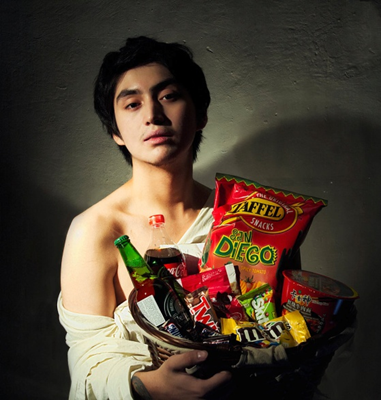
The use of a remake in new media has a certain impact as a fully-fledged message on the internet. Anvar Musrepov’s digital photograph is a role-play self-portrait of the artist himself in the ‘Bairocco’ project, and it is a remake of Michelangelo Merisi da Caravaggio’s early work ‘Boy with a Basket of Fruit’ (c. 1593–1595, canvas, oil, 70 × 67, Galleria Borghese). By utilising the new possibilities offered by digital technology and comparing his conceptual approach with that of the famous painter, Musrepov—in addition to the specific message conveyed in the title of his series—employs the same theatrical effects of an expressive, languid appearance that we observe in Caravaggio’s work. Through his staging and camerawork, Musrepov replicates the painterly effects of light and shadow contrasts (Caravaggism/tenebrism/chiaroscuro), as well as glare and reflections. The warm, flesh-like quality of the bare, illuminated shoulder and the white colour of the draped shawl serve as a neutral backdrop for the full basket held in her hands. The artist replaces the vividness of the real, advertising-style packaging of international snacks in his spacious basket with the tactile perception of the multicoloured fruits – ‘natural objects’ – in Caravaggio’s basket. Researchers at regard the famous Italian artist’s painting as one of the first still lifes he produced. In Musrepova’s project, modern man’s love of mass-produced food reflects the problems of consumer culture in the era of emerging post-capitalism and globalisation. ‘Photography is not merely an index of reality. Even more actively than so-called newsreels, it seeks to participate in history—both public and most intimate, both collective and individual” (Hubert Damish, 1990).
Source: https://www.photographer.ru/cult/person/6788.htm?ysclid=mpia2yigkq460918953 Michelangelo Merisi da Caravaggio. ‘Boy with a Basket of Fruit’. Circa 1593–1595. Oil on canvas. 70 × 67. Galleria Borghese
Source: https://ru.borghese.gallery/kollekcziya/kartiny/malchik-s-korzinoj-fruktov.html?ysclid=mprwx45z7f891416933