
Brief Encyclopedia Signs and symbols of Kazakh culture
Road / crossroads
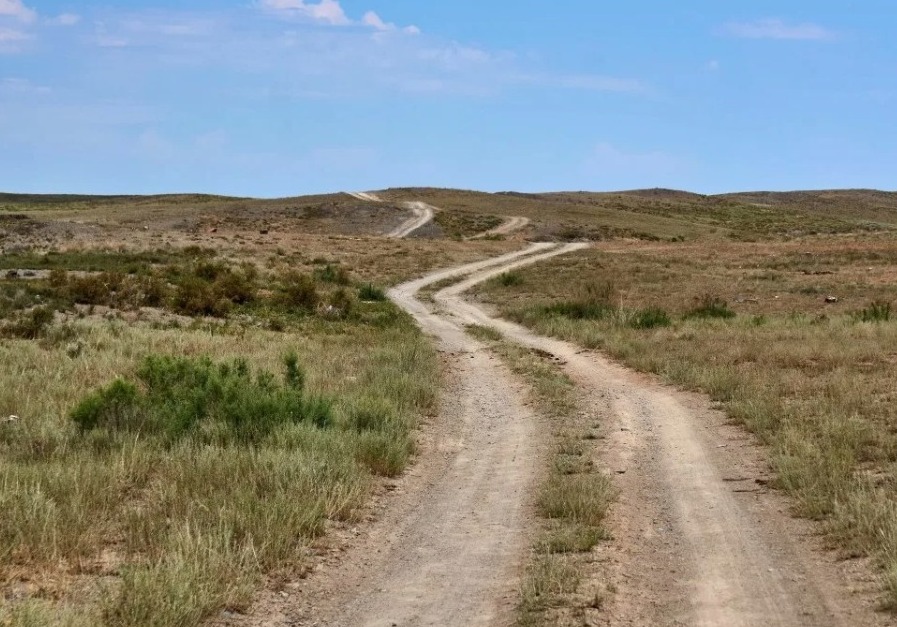
1 cурет.
The symbolism of the road in Turkic culture is associated with the understanding of the Returnable Path (the path of life) and the Irreversible Path (the path leading to the realm of the dead). In Turkic epics, the returnable path of any hero begins at the threshold of their родной home. This concept is also preserved in the remnants of the Kazakh ritual of tusau kesu (cutting the ties). The irreversible path, accordingly, leads to the kingdom of Erlik—the world of the dead.
In the past, Kazakhs had beliefs about the “god of the road on a piebald horse” and the “god of the road on a black horse.” For example, an elderly person, when asked about their age, might hint that the time to mount a black horse and set off on the Path was approaching.
M.M. Sodnompilova notes that in the mythopoetic worldview of nomads, the road is the track laid by the father, while at the level of clan or tribe, it is the direction established by the leaders of nomadic communities. The head of the family determined the migration route, and his sons inherited and continued that path [7, p. 97]. In a broader sense, inheriting the idea of the Path means preserving the way of the ancestors—continuing routes, directions, life choices, and the history of migrations.
In world culture, the symbolism of the crossroads carries contradictory meanings. On the one hand, ancient cities were often designed at such intersections, where temples and pyramids were built. On the other hand, crossroads had a negative reputation, as they were considered places where harmful and supernatural forces gathered. In ancient Greek tradition, this demonic power was associated with Hecate, the goddess of darkness, night visions, and magic, while in Roman tradition, the figure of Trivia, the goddess of three roads, was widespread. The sacred nature of crossroads is also reflected in various rituals among European peoples: they were seen both as places for removing the evil eye and as spaces for casting illness and curses.
In Turkic mythology, crossroads and branching paths also play a symbolic role. A crossroads represents the intersection of opposing yet complementary concepts such as “life and death” and “good and evil.” In Altai mythology, the figure of Kagyr-gan (Kaargan) appears as a mediator between Ülgen and Erlik; at the junction of seventeen roads, he passed judgment and assigned punishment. The importance of crossroads is also reflected in the tradition of placing ancient Turkic stone stelae at such locations. In this context, the crossroads was understood as the center of the four cardinal directions.
One manifestation of these beliefs is the tradition among Kazakhs of building mausoleums along ancient caravan routes or at the intersections of paths between settlements. Practically, such mausoleums also served as landmarks for travelers in the vast steppe.
ШайгОзова Ж.Н., Наурзбаева А. Б.
Краткая энциклопедия знаков и символов казахской культуры.
Алматы: КазНИИК, 2023.