
The building of the Academy of Sciences of the Kazakh SSR in Almaty. From open sources
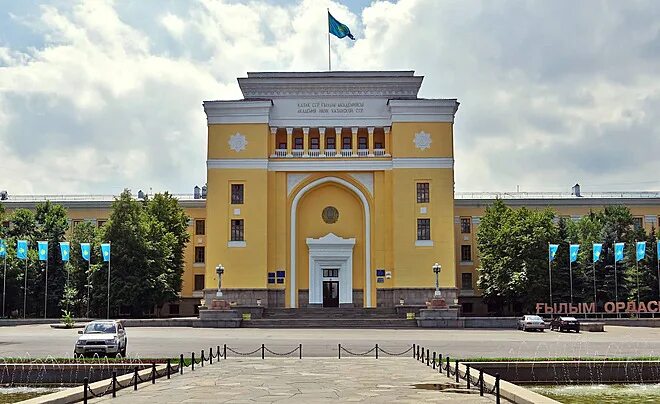
The Academy of Sciences building (architects A. Shchusev, T. Basenov and others) can be viewed as a complex semiotic text in which architectural forms, ornamentation and spatial composition function as signs conveying the ideological and cultural meanings of their time. Two codes interact harmoniously in the building’s architecture: the code of Stalinist Empire style and the national-cultural code. The façade is organised according to the principle of a triumphal axis: the central portico is highlighted as the dominant feature, whilst the side wings are subject to strict symmetry. Here, the Academy of Sciences is visually represented as a ‘sanctuary of science’. The monumental portico with columns, the symmetrical composition, the high stylobate and the emphasised verticality all allude to ancient and neoclassical traditions. These elements function as symbols of authority, order and state stability. The column symbolises the support and legitimacy of the scientific institution as part of the Soviet state. Kazakh ornamentation, incorporated into the décor of the façades, friezes, grilles and interiors, introduces a sense of local identity into the architectural narrative. Ornamental motifs such as the qoshqar muiz serve as symbols of nomadic culture, prosperity and the continuity of tradition. Their presence in a state building symbolises the integration of national culture into the Soviet modernisation project.