Traditional and contemporary art of Kazakhstan

A Virtual Journey into the World of Kazakhstan’s Artistic Heritage

This Web Gallery presents the diversity of artistic practices in Kazakhstan, reflecting the continuity of cultural traditions and the dynamic development of contemporary creative processes. The virtual exhibition features works based on national images, symbols, and themes, as well as artworks by contemporary artists who reinterpret the country’s cultural heritage through contemporary artistic forms, expressive means, and modern technologies.

The selected works demonstrate the relationship between traditional and contemporary art, revealing the distinctive features of the national worldview, cultural identity, and cultural meanings. The presented materials allow viewers to trace how elements of historical and cultural heritage are reflected in contemporary artistic practice, while maintaining their significance and relevance in an increasingly globalized world.

The Web Gallery is aimed at promoting Kazakhstan’s artistic heritage, expanding public access to works of art, and fostering a lasting interest in national culture and art among a wide audience.

‘The Incarnation of Umai: “Past – Future”’. 2015 Mixed media

Abulkhair Akmaral
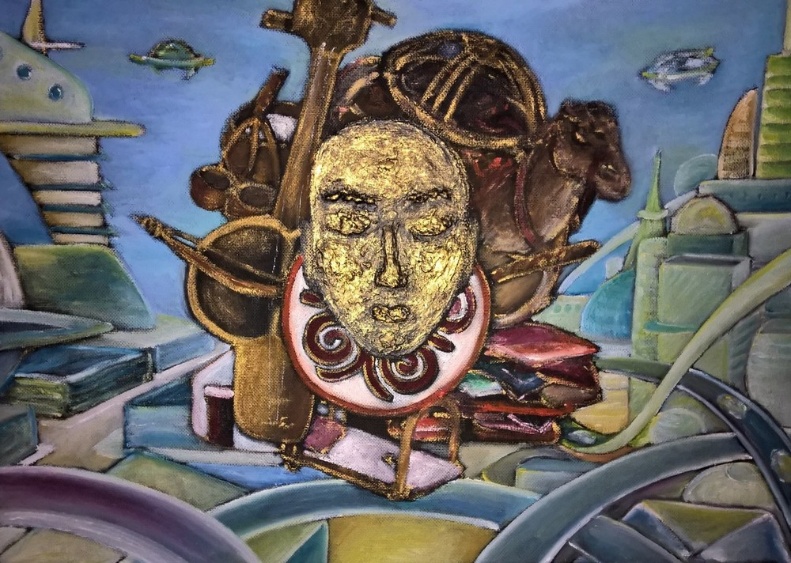
The composition is built on the principle of dialectical binary opposition (‘past – future’), where the two systems of signs are not opposed but are incorporated into a single semantic field. This is significant: the nomadic code (camels, yurts, ornamentation) and the futuristic city do not conflict but coexist as different layers of a single cultural model.The central image of Umai acts as a mediator of time. Her golden mask with closed eyes precludes any association with a specific era, elevating the figure to the realm of the archetype. In this sense, she neither ‘looks back’ nor ‘looks forward’—she captures the continuity of time as a holistic process, which brings the work closer to a mythological perception of time. In this context, Umai acts as a cultural constant, that is, an unchanging archetypal element of the system. In terms of visual semiotics, she functions as a ‘stable sign’, ensuring the integrity of the work’s semantic field.