
The Abai Kazakh State Academic Opera and Ballet Theatre in Almaty. From open sources
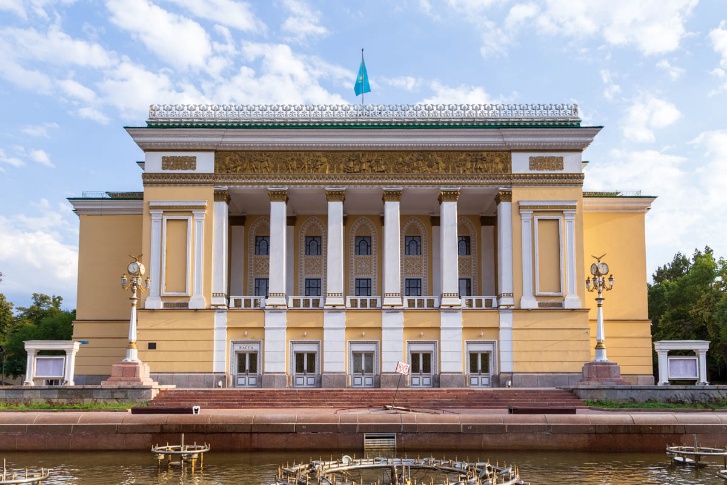
The Abay Kazakh State Academic Opera and Ballet Theatre in Almaty is one of the most significant monuments of Soviet architecture in Kazakhstan, organically combining the principles of Stalinist Empire style, Italian Classicism and traditional elements of Kazakh decorative art. The building was designed by the Moscow architect N. A. Kruglov. Subsequently, architects T. K. Basenov, N. A. Prostakov, V. Bychkov and P. Polivanov were involved in the further development and implementation of the project, whilst Academician of Architecture A. V. Shchusev acted as scientific consultant. The theatre’s architectural composition is based on the principles of monumental symmetry, characteristic of Soviet neoclassicism. The main façade is dominated by a imposing portico with a colonnade, accentuated by a high stylobate and a grand staircase, which lends the building a prestigious, public character. At the same time, classical forms have been reinterpreted here through the incorporation of elements from the national artistic tradition. The façades are richly adorned with stylised Kazakh ornaments, carved cornices, decorative bands and relief inserts based on traditional motifs, as well as floral and geometric patterns. This national character is evident not only in the exterior but also in the design of the interior spaces. The theatre’s interiors are distinguished by their rich decorative features: stucco mouldings, murals, columns, chandeliers and cladding materials are complemented by Kazakh ornamental compositions. During the renovation between 1995 and 2000, ornamental motifs were incorporated into the design of the auditorium and foyer, inspired by the decoration of the ‘Golden Man’ costume, which reinforced the national and cultural symbolism of the interiors.