Traditional and contemporary art of Kazakhstan

A Virtual Journey into the World of Kazakhstan’s Artistic Heritage

This Web Gallery presents the diversity of artistic practices in Kazakhstan, reflecting the continuity of cultural traditions and the dynamic development of contemporary creative processes. The virtual exhibition features works based on national images, symbols, and themes, as well as artworks by contemporary artists who reinterpret the country’s cultural heritage through contemporary artistic forms, expressive means, and modern technologies.

The selected works demonstrate the relationship between traditional and contemporary art, revealing the distinctive features of the national worldview, cultural identity, and cultural meanings. The presented materials allow viewers to trace how elements of historical and cultural heritage are reflected in contemporary artistic practice, while maintaining their significance and relevance in an increasingly globalized world.

The Web Gallery is aimed at promoting Kazakhstan’s artistic heritage, expanding public access to works of art, and fostering a lasting interest in national culture and art among a wide audience.

‘Synyq Muyiz’, 2024. Concrete, metal, relief paste. Photograph by A. Ibragimov

Nuger Dinara
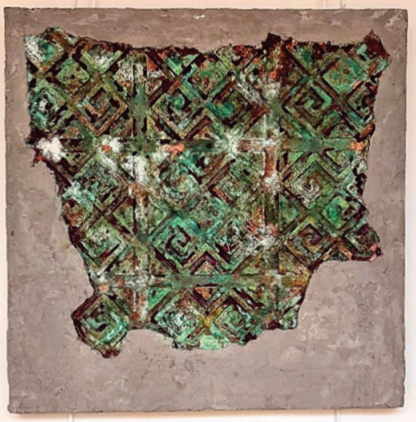
The work ‘Synyq Muyiz’ (2024) is a multi-layered artistic statement that combines plastic experimentation, archetypal symbolism and the semiotics of cultural memory. The work functions as a visual text that requires interpretation through a system of signs, materials and cultural codes.The central motif serves not merely as a decorative element, but as a sign carrying ethno-cultural memory. In traditional Kazakh culture, this ornament symbolises vitality, prosperity, the continuity of the lineage and cosmic order. However, in Dinara Nuger’s interpretation, this symbol undergoes deconstruction: the ornament loses its integrity, breaks down into fragments, and becomes ‘broken’. In doing so, the artist shifts the traditional symbol from the realm of a stable ethnic code into the space of cultural trauma and the rethinking of identity.In the context of the work, the ‘broken horn’ functions as a metaphor for a rupture in historical continuity. However, destruction does not imply complete disappearance.