
The Wedding Palace in Almaty. From open sources
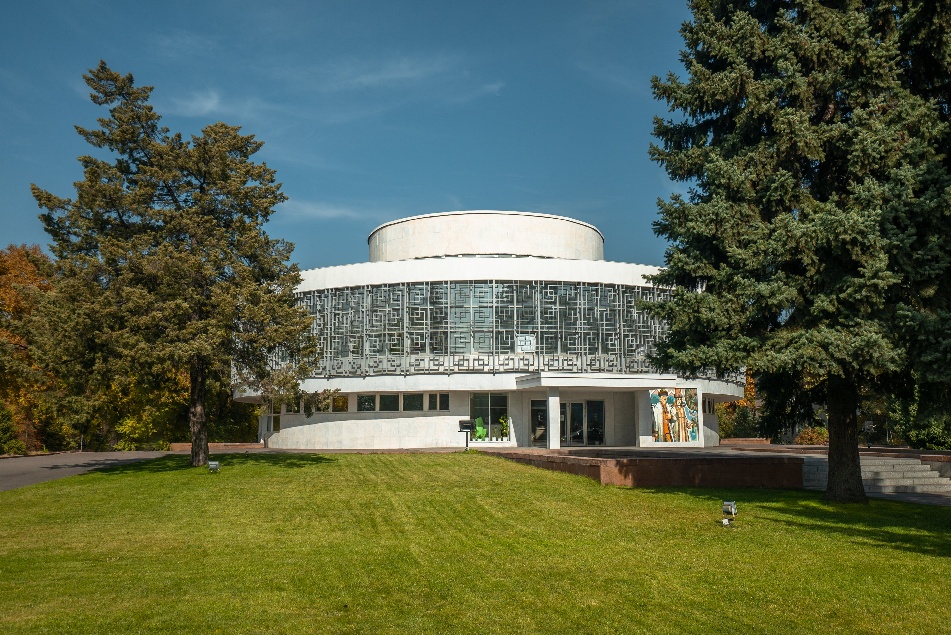
The Wedding Palace in Almaty (1987, architects V. L. Kim, A. D. Katset, N. P. Ripinsky; engineers Y. G. Ratushny, V. V. Kim) is one of the most striking examples of public architecture in the late Soviet modernist style in Kazakhstan. The building was designed as a specialised venue for civil wedding ceremonies, which defined its symbolic purpose and artistic language. In contrast to the monumental public buildings of the Stalinist era, the Wedding Palace draws on the more concise forms of modernist architecture, where the primary conveyors of meaning are the spatial composition, the sculptural quality of the façades and the decorative elements. The building’s spatial composition is based on precise geometry. The dominant cylindrical form is interpreted by researchers as a symbol of wholeness, infinity and harmony. The circle is one of the most universal archetypal symbols in world culture, associated with unity, eternity and the continuity of the life cycle. In the architecture of the Wedding Palace, this form takes on additional significance—it becomes a sculptural expression of the idea of the family union as a self-contained and stable social system. The decorative design of the façades plays a special role. Their design is based on the use of stylised elements of Kazakh folk ornamentation, geometric interlacing and floral compositions. Their incorporation into modernist architecture reflects a strategy, characteristic of Soviet Kazakhstan, of integrating traditional symbolism into public architecture.