
Almaty State Circus. From open sources
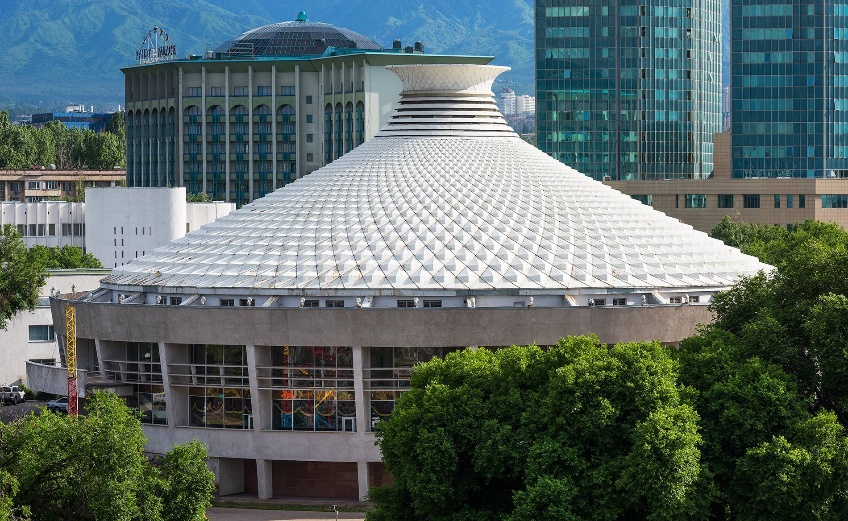
The Kazakh State Circus in Almaty is one of the most striking examples of Soviet modernist architecture from the 1970s and a key landmark in the city’s public centre. The building was designed by architects V.Z. Katsov and I.V. Slonov. Of particular interest is the interplay between modernist architecture and the national artistic tradition. Although there are no direct references to historical forms, the architects sought to imbue the building with a regional identity through evocative imagery. The circular shape of the rotunda and the gently rising dome evoke associations with the traditional Kazakh yurt, where the domed top resembles a shanyrak — a symbol of home, family and unity. This interpretation is in line with architectural trends in Kazakhstan during the 1960s and 1970s, when national motifs were reinterpreted not only through ornamental decoration but also through the building’s spatial composition and form. From an art-historical perspective, the circus dome can be regarded as a dominant artistic image. Its form possesses a pronounced symbolic ambiguity. On the one hand, it reflects the technical progress and engineering achievements of the era of the scientific and technological revolution, characteristic of Soviet modernism. On the other hand, it evokes strong associations with the nomadic culture of Kazakhstan. This gives rise to a unique synthesis of international modernist aesthetics and local cultural tradition.