
Zharyq Dunie, 2016. Organite, oil, embroidery
Alibay Bapanov
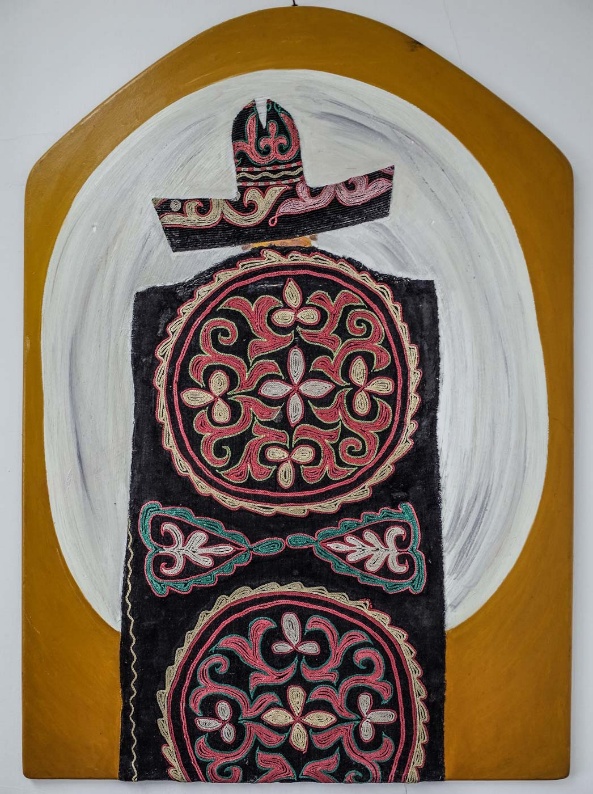
The work ‘Zharyq Dunie’ represents a synthesis of painting and decorative and applied arts. From a semiotic perspective, the work is constructed as a system of signs and symbols revealing a traditional worldview. The central figure acts as a sign of the collective human being — the bearer of cultural memory — whilst the absence of individual features transforms the image from a specific portrait into a universal symbol of humanity and the continuity of generations.The circle of light behind the figure functions as a sign with multiple meanings. It simultaneously refers to the sun, the shanyraq and the cosmos, connecting earthly and sacred spaces. The ornamentation in the composition also functions as a symbolic system. Solar and plant motifs encode ideas of life, fertility, spiritual growth and the human connection with nature. Thus, the work forms a coherent visual text, where each element becomes a bearer of cultural and philosophical meanings.The concept of ‘Zharyq Dunie’ in the Kazakh language has a multifaceted philosophical connotation. This expression denotes not only the ‘world of light’, but also human life itself, perceived as a gift and a space of spiritual existence.