
The ‘Baiterek’ Monument in Astana. From open sources
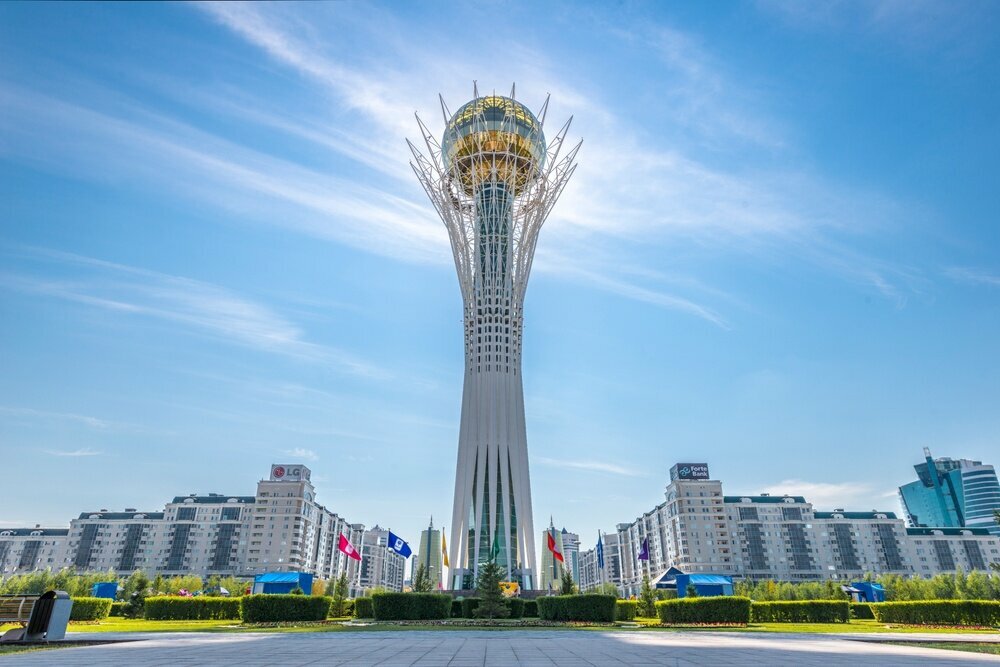
The ‘Baiterek’ Monument is one of the most significant works of contemporary architecture in independent Kazakhstan and a central symbol of the capital. The architectural design was carried out by a team of Kazakhstani architects led by Akmurza Rustembekov. The monument is an example of postmodernist architecture, in which engineering technologies are combined with mythological imagery and national symbolism. At the same time, the monument does not replicate traditional architectural forms, but creates a new national image through a synthesis of a contemporary architectural language and the ancient cosmogonic beliefs of the Turkic peoples.Compositionally, the structure consists of three interconnected parts, corresponding to the traditional model of the universe. The lower level, extending into the ground, symbolises the underworld and the roots of life; the central vertical structure embodies earthly space, the human world; the crowning golden glass sphere is interpreted as the celestial sphere, the realm of the spiritual and cosmic harmony. This three-part structure harks back to ancient Turkic cosmology, in which the universe was divided into the underworld, the earthly world and the heavenly world, connected by the World Tree.The structure’s central artistic motif is linked to the ancient Turkic myth of Baiterek — the sacred tree of life connecting the various levels of the cosmos. According to legend, at the top of the tree, the bird Samruk lays a golden egg, symbolising the Sun, life and the eternal renewal of the world. The architecture of thus takes on the character of a spatial mythological model, embodying one of the key archetypes of Turkic culture.