Traditional and contemporary art of Kazakhstan

A Virtual Journey into the World of Kazakhstan’s Artistic Heritage

This Web Gallery presents the diversity of artistic practices in Kazakhstan, reflecting the continuity of cultural traditions and the dynamic development of contemporary creative processes. The virtual exhibition features works based on national images, symbols, and themes, as well as artworks by contemporary artists who reinterpret the country’s cultural heritage through contemporary artistic forms, expressive means, and modern technologies.

The selected works demonstrate the relationship between traditional and contemporary art, revealing the distinctive features of the national worldview, cultural identity, and cultural meanings. The presented materials allow viewers to trace how elements of historical and cultural heritage are reflected in contemporary artistic practice, while maintaining their significance and relevance in an increasingly globalized world.

The Web Gallery is aimed at promoting Kazakhstan’s artistic heritage, expanding public access to works of art, and fostering a lasting interest in national culture and art among a wide audience.

Creativity. 2012. Mixed media.

Nelly Bube
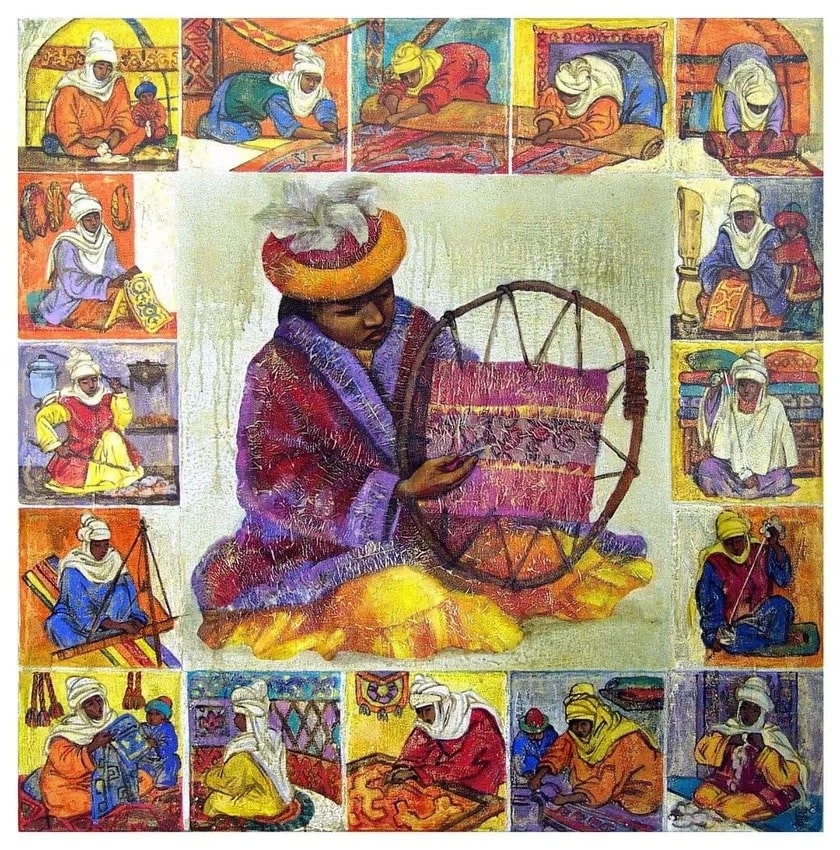
This mixed-media work is a visual representation of traditional women’s craftsmanship as a mechanism of cultural continuity. The composition is organised according to the principle of multi-layered narration: the central figure of the craftswoman engaged in textile production is complemented by a series of peripheral scenes depicting the stages of traditional craft production. From the perspective of visual semiotics, the work functions as a system of signs, where each element (spinning, felting, embroidery, ornamentation) serves as a marker of cultural memory and craft tradition. The presence of other craftswomen in the background brings to the fore the idea of knowledge transmission and intergenerational continuity.The colour scheme, based on a combination of ochre-gold and cool blue tones, strikes a balance between natural-ethnographic and decorative elements.The work interprets women’s craft as a cultural code that ensures the preservation and reproduction of traditional identity within the contemporary visual space.