
The Al-Farabi Palace of Schoolchildren in Astana. From open sources
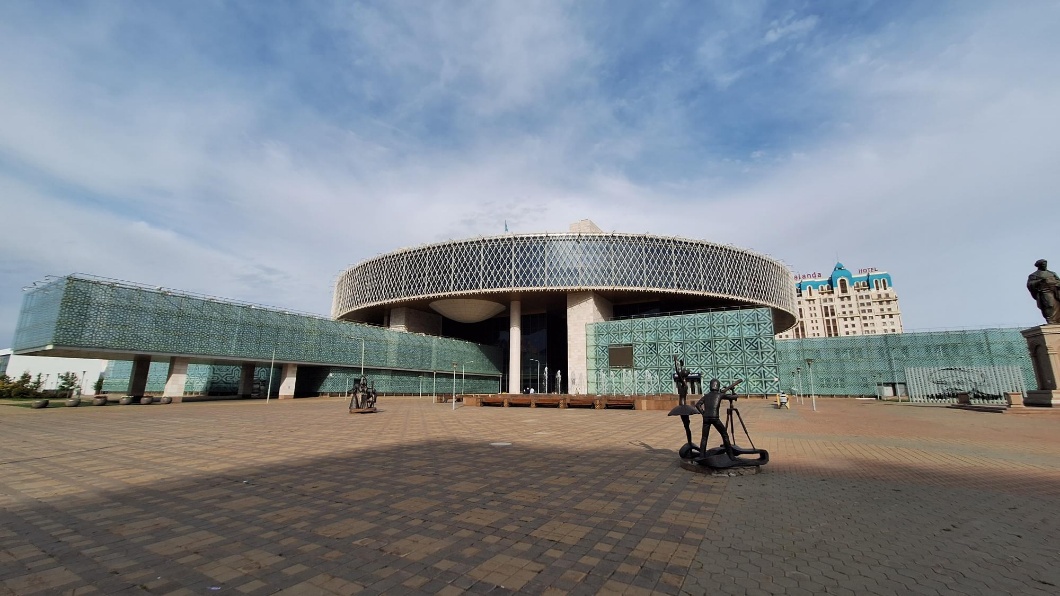
The Al-Farabi Palace of Schoolchildren (2011) is a large, multifunctional centre for extracurricular education, designed to develop children’s scientific, creative and engineering abilities. From an architectural perspective, the building is a contemporary postmodern and functional public complex, where its expressiveness is achieved through its scale, complex spatial structure and the combination of different functional blocks. The building’s composition is structured as a system of interconnected volumes that form internal public spaces — atria, galleries and educational ‘streets’.From a semiotic perspective, the palace serves as a symbol of state policy in the fields of education and the future: it symbolises investment in human capital, the idea of developing an intellectual Kazakhstan, and the creation of an environment where learning becomes a continuous creative process. The architecture conveys the image of a ‘city within a building’, where each block corresponds to a distinct sphere of knowledge — science, art, technology and sport. Stylised Kazakh ornaments — predominantly geometric and botanical motifs — are featured on the exterior and in certain areas of the interior. They set the tone and provide elegant graphic accents in the partitions, panels and stained-glass windows.