
Almaty Museum of Arts in Almaty. From open sources
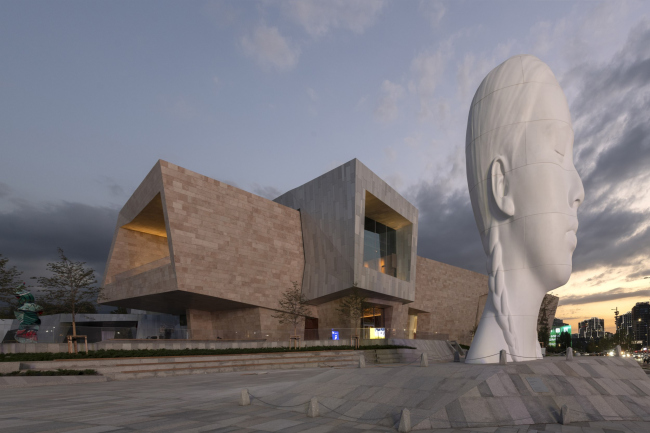
The Almaty Museum of Arts (2025, architect Chapman Taylor) is the largest private museum of contemporary art in Central Asia. The architectural concept is based on the contrast between two volumes: light-coloured limestone, evoking the image of the Tien Shan mountains, and a metallic aluminium block, symbolising the city’s contemporary urban landscape, thereby creating a dialogue between nature and the metropolis. The central space is the Art Street atrium, interpreted as a ‘canyon’, where the interior galleries, terraces and public areas create a continuous flow of space and transform the museum into an open environment for interaction, rather than merely an exhibition venue. From a semiotic perspective, the museum serves as a symbol of Kazakhstan’s new cultural policy, focused on openness, global integration and the development of contemporary art, as well as on rethinking national identity through architectural language. Iconographically, the building draws on the imagery of mountains as a symbol of resilience and natural memory, the canyon as a space of movement and cultural dialogue, and light and glass as symbols of transparency, accessibility and communication. Overall, the Almaty Museum of Arts is an example of contemporary contextual architecture, in which the national identity is shaped through materials, landscape associations and spatial organisation.