
Brief Encyclopedia Signs and symbols of Kazakh culture
Steppe
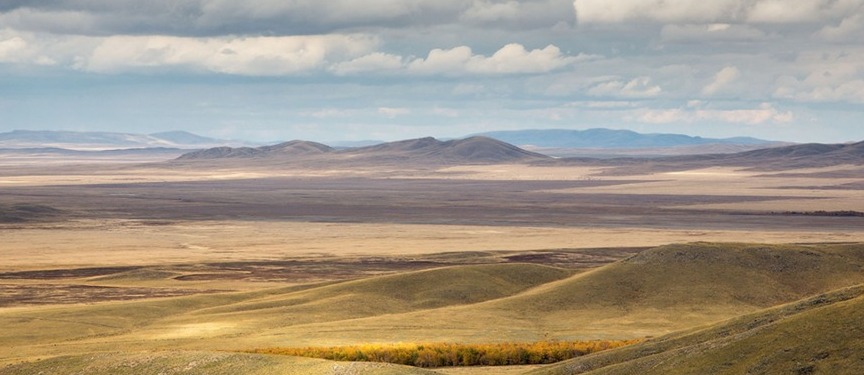
1 сурет.
The steppe (from isïtep — associated with the Old Turkic concept of “to do, to cultivate,” i.e., to освоить and master) is an international archaism describing the vast expanses of Central Asia [10]. In the Kazakh worldview, the steppe is a sacred space. This is clearly reflected in figurative names such as Mother Earth (Zher-Ana), ancestral land (Atameken), Saryarka, the wide steppe, and the Great Steppe. In the oral poetic tradition, the steppe carries various semantic nuances: boundless space, the spirit of freedom, the breadth of the soul, and the imagery of swift horses. The immense steppe is associated with wealth and freedom; the wide steppe is “the original symbol of the Kazakh nomad connected with infinity” [3]. Since ancient times, the Turks have equated the Earth with the mother and the Sky with the father. This idea is reflected in a mythopoetic understanding of the cosmic union of two powerful principles.
A handful of soil has held an important place in the rituals and ceremonies of various peoples. People swore oaths on the soil, used it in magical practices, and carried it with them on long journeys or when far from their homeland. In ancient Turkic beliefs, the Earth possessed powerful purifying and protective forces. The reverence of Mother Earth among nomads was even reflected in the design of footwear: the toes were always curved upward, as it was believed that one must not injure or damage the Earth.
ШайгОзова Ж.Н., Наурзбаева А. Б.
Краткая энциклопедия знаков и символов казахской культуры.
Алматы: КазНИИК, 2023.