
Brief Encyclopedia Signs and symbols of Kazakh culture
Mountain / Mountains

1 сурет.
Among many peoples of the world, including Turkic cultures, the idea of the sacredness of mountains arises from perceiving them as a link between Earth and Sky, the upper and lower worlds. In the Kazakh tradition, the image of the World Mountain is Kök-Töbe (literally “blue/sky-colored mountain”), at the top of which grows Baiterek—the world tree.
According to the traditional beliefs of ancient Turks, springs, lakes, valleys, and mountains each have their own master and spirit. For example, among the Turkic peoples of Southern Siberia (Altaians, Khakass, Tuvans), mountain veneration takes several forms: annual collective prayers, the construction of ritual stone mounds at the foot of sacred mountains, and others. In many Turkic epics, the mountain itself appears as the mother of heroic figures—this is Ötüken, also revered by the ancient Huns. In general, the worship of mountain peaks among ancient Turks was part of the sacred Yer-Su (Earth-Water) cult.
One of the most vivid expressions of the cult of sacred mountains among Kazakhs is the veneration of the Ulytau mountains, along with the widely known phrase: “Have you been to Ulytau, have you eaten the meat of the ular?” On the one hand, this refers to a historical event when representatives of the three zhuz (tribal unions) gathered in Ulytau for the first time and, as a sign of unity against a common enemy, left their clan tamgas on the stones of these sacred mountains. On the other hand, it reflects the sacred origins of these mountains and the strength of the oath made during the ritual consumption of the sacred ular bird.
In Turkic culture, mountain passes also hold special significance. They carry complex semantic meaning: a pass symbolizes transition, change of levels, ascent, and descent. To this day, when passing through difficult mountain passes, Kazakhs tie pieces of cloth or ribbons along the way as a sign of safe passage.
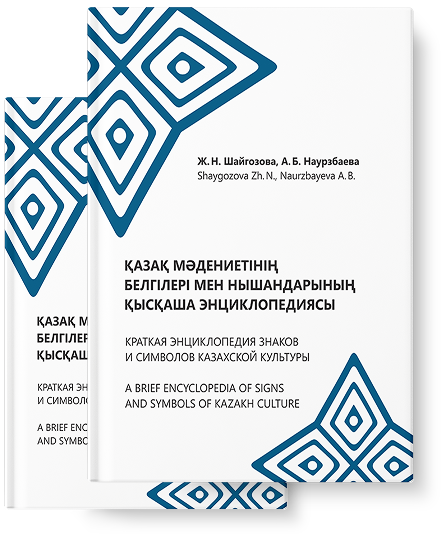
ШайгОзова Ж.Н., Наурзбаева А. Б.
Краткая энциклопедия знаков и символов казахской культуры.
Алматы: КазНИИК, 2023.