
Brief Encyclopedia Signs and symbols of Kazakh culture
Kök (blue, green)

«Kök» is one of the most important symbolic terms in Kazakh culture, also used for dark blue/blue and green (light green). Primarily, blue/blue means eternal sky, eternal life, peace, peaceful soul. Among Turkic Mongolian peoples, sky and blue sky (kök), the supreme deity Kök Tänir, belong to a synonymous series. Blue/dark blue is also found in the name of wolves: kökserek – male, kökzhal – adult. The traditional Kazakh name for the hill structure is «kök tas» (literally: blue stone), which associates it with the sky, the Eternal Heaven – the abode of the Aruahs. Blue is also the symbol of water (the symbol of rebirth). In general, the Kazakhs used the term «kök» for everything «given by heaven». Finally, green is traditionally associated with the awakening of nature and the birth of new life. Hence «kökmaisa» – young grass, «kök shöp» – green grass, etc., i.e. the term is associated with life, renewal, spring: «kökteu» – spring meadow/becoming green, «köktem» – spring, «kösegesi kögeru» – being happy/being happy, etc. As for the colour combinations, the combination of dark blue/blue and yellow is symbolic, understood as the union of heaven and earth – Tengri and Umay. The Turks and Mongols believed that they were opposite each other and that everything earthly came from their union. The word «kök» can also be used in a negative sense, as an exaggeration of qualities: «kök zhalqau» – a real slacker, «kök mylzhyn» – leaky vessel, etc. Also in the vocabulary of Turks there is the term «yashyl», which was transformed into the Kazakh «zhasyl» (green). It is a symbol of growth, increase, cultivation, multiplication, and in Turkic culture it is a symbol of paradise gardens, youth and abundance in Islam. Blue and green are often used in embroidery, clothing decorations, and on woven fabrics. In general, Kazakhs associate green and red colours with youth, which are prevalent in young people’s clothing. Blue also plays an important role in world culture: in Europe it is the colour of fidelity and mystery, and the concept “blue blood” is used for nobility. Among the Poles, there used to be a custom of painting the bride’s house blue; blue is a sacred colour reflected in the clothing of the Tuareg, some inhabitants of the Sahara; in Chinese art, the blue face belongs to ghosts and spirits, and much more. The next in the hierarchy of sacred colours is yellow – sary, which is also polysemantic. On the one hand, it stands for the sun, movement and vastness. On the other hand, it stands for melancholy, sadness and long waiting: sary uaiym, sary qayğy, etc. At the same time in Kazakh language there are also positive connotations: “sabyr tübi – sary altyn”, which means patience – gold. The yellow colour is actively expressed in the ceramic art of South Kazakhstan, where archaeological research has shown that the so-called «yellowpink pottery» was particularly popular. Researchers connect the predominance of yellow (lemon yellow) colour with the Sufi tradition: yellow (colour of the
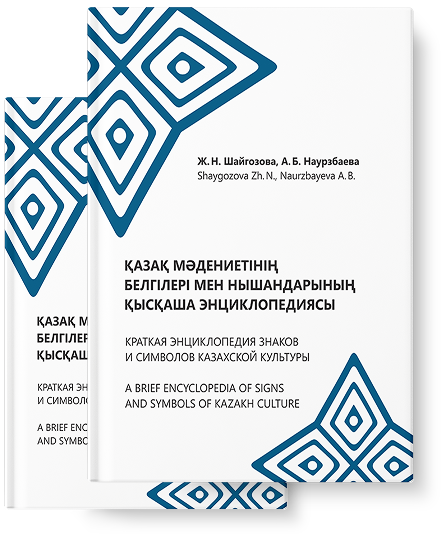
ШайгОзова Ж.Н., Наурзбаева А. Б.
Краткая энциклопедия знаков и символов казахской культуры.
Алматы: КазНИИК, 2023.