
Brief Encyclopedia Signs and symbols of Kazakh culture
Aq qalpaq / aiyr qalpaq
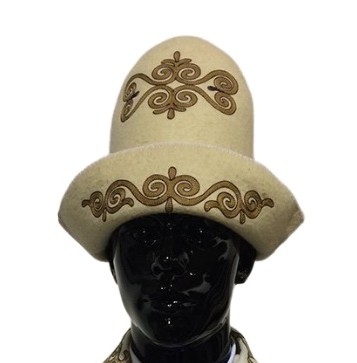
silk and bobbin lace. Historians believe that this headdress served as a crown («täzh» – in Kazakh) and was an indispensable attribute of the traditional costume of the Chingizids (the ruling elite). This headgear rightly belongs to the most archaic variants, and the earliest archaeological evidence of its existence on the territory of Kazakhstan is the famous «Golden Man» of Issyk. It was an inseparable attribute of a girl’s ritual wedding dress, presented as a gift by her father and forming an important part of the bride’s dowry. The saukele thus emphasised the transitional status of the woman, the future mother. According to the scientists’ reconstruction, the coneshaped saukele with a sewn-on back (which was also richly decorated) embodies the World Mountain, a model of the universe that unites three worlds: the upper, the middle and the lower. The whole composition of the saukele decoration, which was unique and inimitable in each case, corresponded to the stable symbols and represented a certain semiosphere. The most common are the ornamental symbols «the sacred tree of life», «ram’s horns» and others. Silver or gold-plated pendants and plates of all types and shapes were also sewn to the headgear: Silver, according to Kazakh beliefs, has protective powers, and such «participants» of the decorative composition as coral, pearl, carnelian and other
ШайгОзова Ж.Н., Наурзбаева А. Б.
Краткая энциклопедия знаков и символов казахской культуры.
Алматы: КазНИИК, 2023.